
Why are the F1 regulations dangerous? The pilots explain it
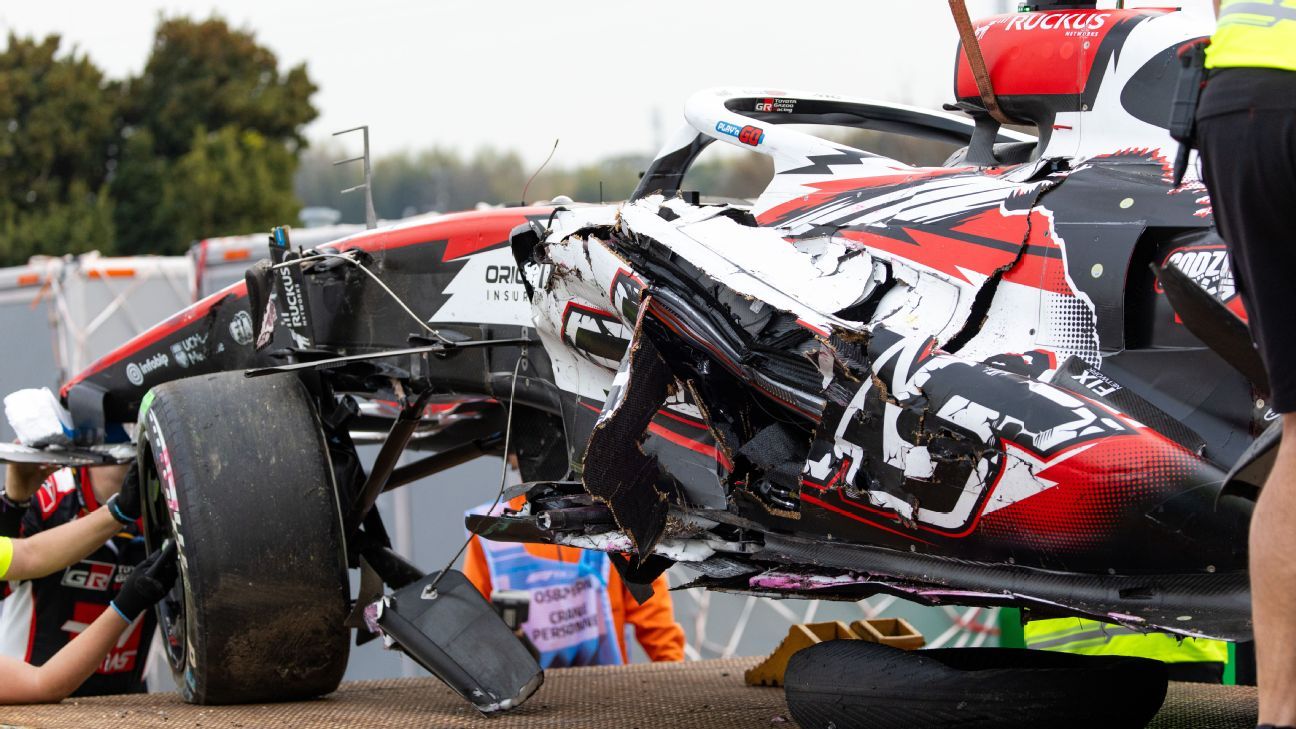
In the Japanese GP, Oliver Bearman’s accident occurred due to factors that several pilots had already warned would occur.
Oliver Bearman reaches turn 13 of the Suzuka Circuit with a full power display and applies the boost to move to Franco Colapintowho comes in recharge mode, that is, slow. Then, the Englishman’s extra 50 kilometers per hour becomes a whiplash that propels him against the Alpine. The Haas number 41 does not pass, it avoids contact with the Argentine, but goes to the grass, spins and has a collision with the fence with a force 50 times the force of gravity, that is, about 40 thousand kilos.
The young British man comes down scared and limps in his right leg. It is the first strong call: the regulations of the Formula 1 It causes forced, dangerous overtaking and where the pilot is a passenger. That should be enough to ring alarm bells and seek a solution, but instead, the FIAwho was warned by the pilots of these risks from day 1, pretends not to see much and promises to “analyze” things.
Where the F1 sees spectacle, the pilots detect serious danger. It is like this, the FIA and the Formula 1 They do not have time to see the damage they are doing to the sport with the 50-50 engines, because they are enthralled with the ratings, metrics and balances that the very ‘entertaining’ 2026 season throws at them, full of overtakes and actions that were not seen before. Only Melbourneaccording to Applehad an average of 1.1 million more viewers than the 2025 average, in addition to 120 overtakes, up from 45 last year. That, of course, is worth more than the integrity of any human being.
Records of overtaking, changes in the lead and unpredictable starts are the ‘finger’ that aims to cover that ‘sun’ which is the great risk represented by having cars that literally ‘sit’ on the straights and stroll through fast curves in search of recharge while, at the same time, others find frenetic acceleration thanks to the ‘boost’ or ‘overtake’, buttons that deliver the power.
It’s like suddenly merging into the left lane of the road or the freeway with the first one on the right where slow cars join. The recipe for chaos.
The pilots of the Formula 1, With the exception of those who win or get on the podium, they are anguished and have expressed their concern about the regulation which, beyond being an affront against the basic principles of sports driving (which should already be enough to realize that the path is wrong), is a time bomb, which managers see out of the corner of their eye as they enjoy the week’s sales numbers.
Bearman says the pilots had warned him
“This is something that we talked about on Friday with the drivers and stewards, that we had to be more prepared for these enormous deltas (speed differentials). As a group we warned the FIA what could happen and this is the unfortunate result,” denounced Bearman, after the accident in the Japanese Grand Prix.
The GPDA (Grand Prix Drivers Association) is the F1 drivers’ union, and through it they have expressed their concern for safety.
Fernando Alonso almost predicted the Bearman accident
No less before the third Grand Prix of the season, the one we experienced in Suzukithe pilots had again expressed their complaints, as Bearman stressed.
Before, Fernando Alonsoalmost like a prophet, said in an interview with DAZN in the middle of the grid that the new regulations were not fun at all, that passing ‘unintentionally’ was not spectacular.
“No, no fun, what fun are you going to have accidentally overtaken? The overtaking that there is now is unintentional; suddenly you come across a battery higher than the car in front of you and, either you crash into it, or you overtake it. It’s an evasion maneuver more than an overtaking out of courage and I’m going to brake later than it or I’m going to pass it through a curve on the inside, on the outside, doing something different. Now you find yourself with less battery than your rivals or with more battery and you overtake or you advance”, explained the two-time world champion and dean of the drivers of F1the man who is 44 years old and has won 428 Grand Prix races.
Lando Norris explains why the driver is not in control
That of the man of the 23 seasons in the F1absolute record, of course, is not the only dissenting voice with the list of changes of the FIA to the 2026 single-seaters, Lando Norrisreigning champion of the category that emerged as the highest expression of motor sport in 1950, has also been critical.
“Yes, the races may look great on TV, but the driving experience in the car probably isn’t as authentic as it should be. (For example), I didn’t really want to overtake lewis (hamilton). Only my battery delivers power, something I don’t really want, but I can’t control. So I pass him, but then my battery is empty and he just speeds past me again,” Norris said, after Suzuki.
“If you just depend on what the power unit does, the driver should at least have control over it, and that’s not the case.”
“I have to lift my foot, otherwise I collide with it and I can’t accelerate again. Because if I accelerate, my battery delivers energy, but I don’t want that,” details the pilot of McLaren.
Villeneuve, F1TV commentator, believes Colapinto was wrong
But, not everyone thinks the same, there are ex-pilots like him Jacques Villeneuve, who believes that the problem of the incident between Bearman and Colapinto was the Argentine, because – he said – he moves.
“I was surprised that nothing was done about Colapinto, because this is what you don’t want to see: a little movement just as you approach the corner in such a dangerous place, where it’s actually, I guess, regenerating energy.”
“Now we have seen the danger of this new regulation. The difference in speed with some movements can be very dangerous and there was nothing Ollie could do. And I don’t understand what Colapinto was thinking moving at such a low speed in such a dangerous place,” said the 1997 champion of the F1 in the transmission of the F1TV official streaming of the App of the category.
LAP 22/53
Bearman into the barriers! 💥
⚠️ SAFETY CAR ⚠️#F1 #JapaneseGP pic.twitter.com/yhlscJPGTP
— Formula 1 (@F1) March 29, 2026
Komatsu contradicts Villeneuve, Franco did not move
What Villenueve said he saw and his surprise that Coplapinto had not been punished, does not agree with anything observed by those directly involved in the mishap that, for more than one, made him feel that his blood sugar had risen.
“No, he didn’t move. From what I saw, he didn’t do anything different. On the previous lap, his speed was exactly the same, so we knew what we were dealing with.”
“It’s just that we were deploying more there, so even with normal laps, we had an advantage of 20 kilometers per hour. That’s why (Bearman) wanted to go that way. Then he used the ‘boost’ button, but that meant that the speed there was 50 km/h (more than Colapinto’s),” explained the team leader. Haas, Ayao Komatsu”.
Franco Colapinto: the spreads are very high
For his part, Colapinto, who was a hostage to the programming of his car’s software that decides where he will clip – where he will recharge on curves and other things – was as shocked and confused as Bearman.
“It was really strange, to be honest. I was a little exposed. I think the speed difference was so big, so wide. It’s almost like one was on an out lap and the other was on a flying lap.”
“I think it becomes really complicated when the straights are not straight and he is turning, because we are not in a straight line, we are in a curve a little bit. And when I looked in the mirror, he was spinning in the grass. Even spinning he overtook me, so imagine the difference in speed. I think at some points it becomes really dangerous. I’m glad he’s okay,” described Colapinto, whom in training in Bahrain he was about to overtake and ram in the straight, Lewis Hamilton, a few weeks ago and that at the start of the Australian GP, he also had to get rid of Liam Lawson, who started disproportionately slower.
Checo Pérez: It was a matter of time before it happened
The Mexican of Cadillac, Sergio ‘Checo’ Pérez He has also said it on several occasions, the Mario Kart mode, in addition to detracting from the role of the driver, is dangerous.
“It’s massive speed differences you can have between cars. It was just a matter of time,” he said. Czech Perez in Suzuki.
Verstappen is not alone in his claims
Whom some have grabbed like a piñata for being vocal against the regulations and telling the F1which is a Formula E on steroids, he is the four-time champion, Max Verstappen. But, the Dutchman is not complaining because his b is a disgrace, he is complaining because there are no fast corners and because the deltas (speed differences) are absurd.
“One car is practically without power, while the other uses mushroom mode (Mario Kart). Then you immediately have a difference of 50 to 60 kilometers per hour. That is really huge,” declared Verstappen.
This fits like a piece of a puzzle with what Alonso mentions: “Suzuka disappeared a little, as did the fast corner in Australia, which we always saw spectacular images in 10 and 11, Jeddah will disappear, Eau Rouge will disappear, all the corners in the championship will disappear. It is a new Formula 1, you may like it more or less, but the fast corners are now charging points, there you recharge the battery, then on the straights you have a little more power and the driver, the only thing he does is not push in the corners, which is a little frustrating.
Carlos Sainz predicts worse accidents if something is not done
The one who definitively broke down, like someone unraveling a blanket, the problem of the rules, was the Madrid native Williams, Carlos Sainz and predicted that accidents worse than Bearman’s could come on tracks like vegas either Baku, if the FIA and FOM don’t do something.
“The five-week break at Formula 1 It suits him very well. The accident that we have seen with Bearman, the pilots have been warning the FIA and the FOM, that it was a matter of time before an accident like this happened. “We have speeds of 30, 40, 50 kilometers per hour using the ‘boost’ and this accident was a matter of time.”
“I think this accident was 50 G’s in Suzuki with an escape, now imagine that we are going to Las Vegas, that we are going to Baku and the same problem that Ollie had, which Franco surprised him, we have on another circuit at higher speeds as we will have in vegas and Bakuthen no escape.”
“I hope the Formula 1 reconsider and the teams do not get too forward, because it is clear that this regulation has loopholes and has problems that must be solved before anger Miami and before going to other types of circuits,” Sainz said in Spanish in the corralito with the press, after the Japanese GP.
Making drastic changes is impossible, you cannot reverse a technology that cost hundreds of millions and years of research, but has major flaws that range from competitive to the most important, security.
No one should wait for a crash that throws a car over a fence to do something. Reducing the percentage of kilowatts of the electric motor and ensuring that the cars have constant power throughout the lap may be a solution, but we will have slower cars than many backup categories.
Is that embarrassment preferable, or the integrity of the pilots?
