
What the advanced statistics of the Valencia Basket-Barça final say
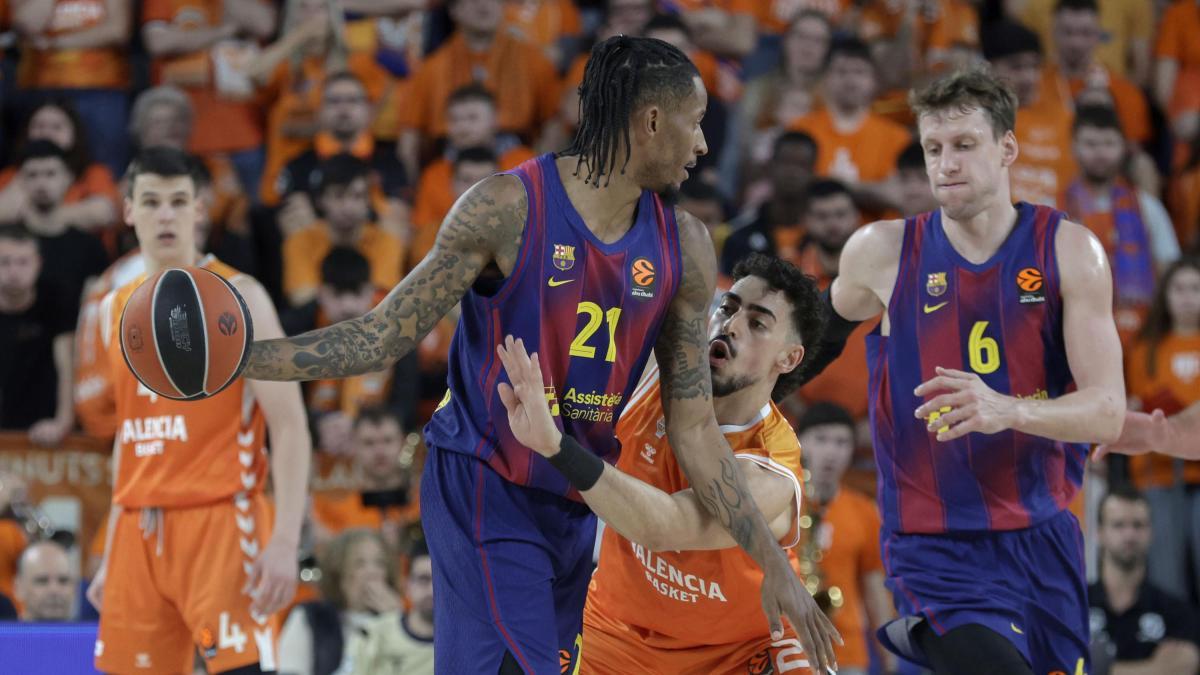
Barça and Valencia Basket are preparing their assault on the Endesa League title, the final of which will begin tomorrow (8:00 p.m.) at the Roig Arena, aware that the path to success involves imposing one’s own style over that of the rival. If Pedro Martínez’s team manages to turn the series into a constant back-and-forth, with a devilish pace and very short attacks, they will have a lot to gain. On the contrary, the Barça team will try to slow down the game, go for a static attack and hinder their rival’s development as much as possible.
The statistics do not lie: Valencia’s pace of play is the fifth fastest in the ACB (77.2 possessions per game) while Barça is the second slowest among the 18 teams (72.7). The bet that has worked so well for the ‘Taronja this season is that of ‘run and gun’, with quick transitions that, if possible, end with a triple. No one in ACB has taken more threes this season than the Valencians, 32.8 attempts per game.
Barça already managed to neutralize that system in the Euroleague match played at the Roig Arena, in which they won by a pyrrhic 62-66. “We must play as little as possible in half court. In that game they did a great job to slow us down and lower our scoring. We have to defend hard, rebound, run and shoot with confidence,” Valencia player Omari Moore warned yesterday. “We must continue with our style, with our idea. We have to play fast, shooting with confidence,” he added.
And they think the opposite about Barça. “They should not play their easy style. It is based a lot on running a lot and the game going into many possessions. The last time we played here we suffered it (77-102). As long as we control that and are solid in our game plan, we will be fine,” Darío Brizuela warned yesterday.
Volume versus success
Their great shooting volume leads Valencia to score many triples (1st with 11.7 on average). Barça’s approach to the three-point shot is the complete opposite: many fewer shots (10th with 24.9) and converted ones (10th with 9.8) but a clearly higher level of success (2nd with 39.5%). For the Barça team, the key is not volume but aim, whether due to a good selection or the talent of its players.
Closely linked to Valencia’s commitment to the triple is its great performance in offensive rebounding, which is always easier for the attacker on long shots. Pedro Martínez’s team captures 37.7% of the rebounds after their own shots, more than any other team in ACB. Barça remains at 29.9%, in a discreet 14th position.
Each team exploits its strengths, and Barça is not doing too badly with theirs. Another important advanced statistic is field goal efficiency, which takes into account two-point shots and three-pointers with a weighting. There, Barça is the best (59.9%) given its high percentage in both two-point shots (1st with 60.4%) and three-pointers (2nd with 39.5%). Barça shoots less but with more success than Valencia (6th with 55.7%).
Apart from the rhythm, the use of the three-pointer, the performance in the offensive rebound and the general success in the shot, the other big difference between Valencia and Barça is in the way in which each team generates its points. The Taronja team plays in a much more collective way, sharing the ball very well and with a special sensitivity for the extra pass. For this reason, it is the third team that obtains the most baskets after an assist (61.2%) while Barça is the worst in this section (48.8%). It is easy to understand if we think about the usual ‘one against one’ of Kevin Punter, Will Clyburn or Darío Brizuela or in the balls to the low post to Toko Shengelia or Clyburn himself. Barça, for this reason, depends more on the talent and success of its stars than Valencia, which is much more coral.
