
NBA Way to Goat for franchise: Philadelphia 76ers
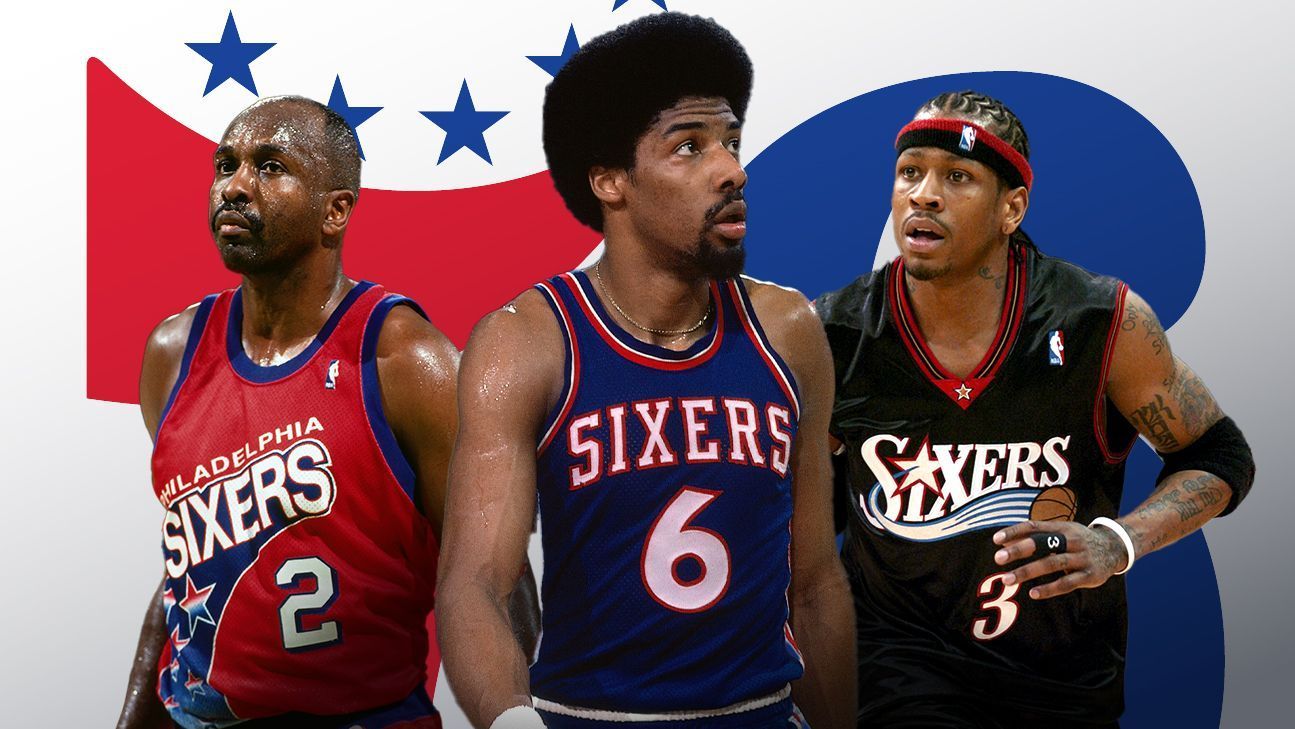
Welcome to the Ranking Goat Franchice to franchise. Today is Philadelphia 76ers: Wilt Chamberlain, Julius Erving, Allen Iiverson and much more.
Welcome to Ranking Goat franchise to NBA franchise. Before starting, it is important to define the evaluation criteria: it is not the best players but the most impact for the team in their history. We put, in a situation, trajectory, championships won, faithfulness and, of course, quality.
This committee composed of a single person has decided to immerse yourself in swampy waters to bring definitions. We will be inflexible. We will be dogmatic. And we will bring answers.
Made the respective clarifications, We get into the Top 10 of Philadelphia 76ers.
Adjust your belts. It is time to take off.
10. Maurice Cheeks (1978-1989)
Close the top ten of the Sixers an intelligent man, who stood out in the story both in the role of player and coach. In a superstar franchise, Cheeks looks like the best pin in Philly’s story with 6,212 assists (1,672 more than Hal Greer, his immediate persecutor) in eleven years of career as a Sixer.
Cheeks won a championship with the franchise in 1983 and also looks like the maximum robator of balls of all time in Philadelphia with 1942, almost 300 more than Allen Iiverson, which is second (1,644). Chosen in the 36th place of Second Round of Draft in 1978, his career was a resounding success: four times All-Star and four times in the first defensive team of the League.
His number 10 was removed by the Sixers in 1995. He entered the Hall of Fame in 2018.
9. Joel Embiid (2014-present)
His career is, today, at a turning point: o Delogs to become the star that Sixers need or can finally immerse themselves in the ostracism of those who could do something and did not arrive. Embiid is a current NBA figure, but the injuries have had it bad to bring. In spite of everything, it is already the ninth best Sixer of all time.
It was MVP in 2023, in his hand in hand in front of Nikola Jokic, and that made him grow in considerations. Seven times there to the date of the date, the Cameroonian center who could represent his country, to France, but ended up playing for the United States internationally, was twice a maximum scorer of the NBA (2022 and 2023), won the Olympic title in Paris 2024 and averaged 27.7 points and 11 rebounds for appearance in his career in the franchise.
Jojo, with 31 years, still won anything. If you get something, you will climb several positions in this ranking. For now it is a regular serial hero and a postseason ghost.
8. Dolph Schayes (1949-1964)
Schayes is one of the NBA players-transition. He played 15 years in the franchise, but 14 of them were in the Syracuse Nationals, before relocation in Philadelphia. Internal hierarchy, he retired with 19,249 points. It was 12 times All-Star, won the 1955 title, and appears in the 50s and 75 best players in history. A legend in years in which television took its first steps.
Schayes, six times chosen in the best quintet of the NBA, entered the Hall of Fame in 1973. Between 1955 and 1960, their double-double averages were above 20 points and 12 rebounds. Absolute domain.
When he retired, he stayed two more years leading in the Sixers, where he won the Coach Award of the Year in 1965-66. His number 4 was withdrawn on March 13, 2016.
7. Billy Cunningham (1966-1972 and 1974-76)
Seventh place for Kangaroo Kid! He played a total of eight years in the franchise, in two different stages. It was a pillar in the decades of ’60s and ’70, strategic partner of Wilt Chamberlain and Hal Greer, and conquered with the Sixers the title of 1967. 16,310 points (21.2 per game) and 7,981 rebounds (10.4). His numbers are eloquent.
Cunningham joined four ideal NBA teams and is part of the teams of best 50 and 75 of all time. His number 32 was withdrawn by the franchise, he is in the Hall of Fame since 1986 and is recognized to have loaded the team on his shoulders when Chamberlain went to Los Angeles Lakers in 1968.
Although in this Goat ranking we are going alone for the player section, a fact improves its impact on the Sixers universe: in 1983 he was champion as coach with Philadelphia.
6. Hal Greer (1958-1973)
Like Schayes, Greer was in the franchise in the years of Syracuse and also after the change to Philadelphia. Ten times All-Star, NBA champion in 1967, Greer belongs to the teams of best 50 and 75 in history. His number 15 is removed by the Sixers – it was the first to reach this honor – and well deserved he has it: he was one of the best perimeter of all time, with 19.2 points, 5 rebounds and 4 assists for appearance in his 15 years of career. He never changed equipment and, at least in this ranking, the loyalty pays.
It is the top scorer of all times of the franchise. He was also chosen seven times in the second ideal NBA team (1969 to 1973). He played 1,122 games. “I would like to be remembered as a great player, but above all things consistent,” he once told Philadelphia Daily News.
Consistency. There is no more fair word to describe your fantastic career.
5. Charles Barkley (1984-1992)
Sir Charles in his years of Philadelphia was a difficult foal to domesticate. An low stature wing, but with incredible force. A huge power from Alabama. Barkley, who had Male Malone as a mentor, arrived in the mythical 1984 draft and had eight years of career in Philly. Eleven times All-Star, six of those in their stage in Philadelphia (1987–1992), was five times in the ideal NBA team and four elections were in its time with the Sixers.
Barkley was a force of nature. He averaged, in 610 games with the franchise: 23.3 points, 11.6 rebounds and 3.7 assists. Huge. Member of the 1992 Dream Team and the third Dream Team in 1996, his number 34 was removed by the franchise, an honor he also shares with Phoenix Suns.
It was, what is said, a controversial player. His phrases with a language of fire never went unnoticed and played, as he got used to at the time, to the edge of the regulation. It was MVP of the NBA in 1993, but I already played for the Suns. He could have been above this list, but he lacked the strawberry of dessert: winning a ring, something he could never in his career.
4. Moses Malone (1982-1986 and 1993-1994)
‘Fo, fo, fo’. The prediction in the 1983 finals defined it forever. For a defeat it was not a complete sweep, as Moses anticipated: they achieved that year a 12-1 brand to beat Los Angeles Lakers in the NBA finals and win the championship.
Malone was, perhaps, the most undervalued star in the history of the NBA. He was a wonderful player, an unparalleled botero, especially offensive. He played only four years in the Sixers, but they reached to sign a pact with eternity. MVP of the 1983 finals, won three MVP in his career (1979, 1982 and 1983).
Its number 2 is removed by the Sixers and 24 was removed by Houston Rockets. He averaged, in his career, 20.6 points and 12.2 rebounds per meeting. Nicknamed ‘The Chairman of the Boards’, Malone was, in his career, 13 times All-Star, he reached eight All-Nba elections, converted 27,409 points (12 ° throughout history) and fell 16,212 rebounds (5th).
Irreplaceable player, he was induced to the Hall of Fame in 2001. He died very young: from a coronary disease at age 60.
3. Wilt Chamberlain (1965-1968)
Welcome the record man to the pedestal of Philadelphia 76ers. Could I have been higher? Possibly, but competition, in these lands, is fierce. And his place in history is this for the short time in the team. He won a championship in 1967 with the franchise after being observed sideways, many times, for pursuing personal numbers instead of reaching collective merits.
Chamberlain, perhaps the best physicist who once stepped on a NBA court together with LeBron James, won three of his four MVPS in the Sixers, and his number 13 is retired both here and in Kansas Jayhawks, Harlem Globettters, Golden State Warriors and Los Angeles Lakers. His numbers were supernatural: 27.6 points, 23.9 rebounds and 6.8 assists in 277 games with 76ers.
Wilt integrated the teams of best 35, 50 and 75 in history. He played only three and a half years in Philly, reached the ideal team twice and despite soon that he was fifth in rebounds throughout the history of the franchise with 6,632.
The Big Dipper, as he was known, was induced to the Hall of Fame in 1979.
2. Allen Iiverson (1996-2006)
The Answer was a countercultural genius of the NBA. He played ten years in the Sixers, did not win any championship but was still unforgettable. For his game. For his way of being. For his way of acting. He modified scenarios, urbanized the league, built a community. All being a 1.83 meter escort. Incredible.
Iiverson was MVP in 2001, eleven times All-Star (eight in Philly), four times maximum scorer of the NBA (all in its years as Sixer) and integrated, in the decade in the franchise, three times the ideal team of the league and another three times the second best quintet.
His personality marked a generation on fire. Difficult to control, Iiverson was radioactive material. Dangerous for everyone: for yours, but much more for rivals. On an inspired night I could ridicule even Michael Jordan himself. Its number 3 was removed by the Sixers in 2014.
Second in the history of the franchise in points and robberies, and third in assists, he entered the Hall of Fame with the 2016 class.
1. Julius Erving (1976-1987)
Dr. J is synonymous with elegance, class and virtuosity. He is the deserved best player in the history of the franchise because he was always aspirational. A revolutionary of the heavens, who inspired other stars to follow his steps. He furrowed the way for the rest. From his face Afro to his unforgettable shoes, Erving was, what is said, a registered trademark of American basketball. A game of the game.
MVP in 1981, and champion in 1983, arrived at the League after being a LEGENDA of the ABA, where he conquered three MVP awards, two MVP of playoffs and two championships. In the NBA it never changed franchise: it was eleven times there with the Sixers, and was seven times in the ideal team, five in the first and two in the second.
Dr. J was a precursor in terms of overturns. In a basketball accustomed to the ground, he was always in the air. Rucker Park legend had character, skill and courage. His number 6 was removed in 1978 and entered the Hall of Fame in 1993. Between ABA and the NBA he passed the border of the 30,000 points.
An unmatched icon that is still to speak every time it occurs in the different scenarios of the League.
