
Maradona’s doctors did not act on signs of heart failure, according to expert
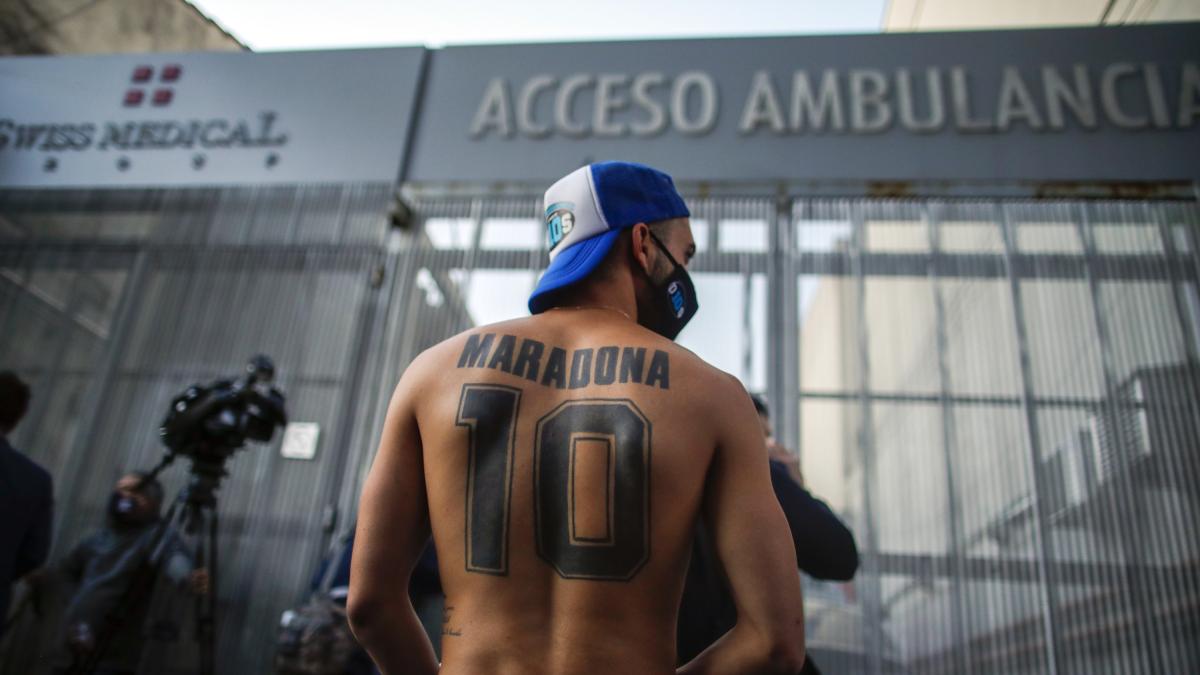
The cardiologist Gustavo Di Niro, who was a member of the Interdisciplinary Medical Board created in 2021 to evaluate the circumstances of the death of Diego Armando Maradona, assured this Thursday in the trial that the doctors in charge of the star’s health did not act despite the numerous alarms compatible with heart failure.
Di Niro referred to the “alarm signs” that Maradona presented during his last two weeks of life, in which he was subjected to home treatment, such as fluid accumulation, breathing problems, an altered state of consciousness and said: “When you see these elements, you have to think that the patient may be having heart failure.”
The cardiologist also referred to the tachycardia and high blood pressure that the nurses recorded and stated that if he received a patient in his office with those values ”he would medicate him.”
The expert warned that in the face of these alarm signs the correct thing would be to “increase the complexity of medical care” but that, in this case, “the doctors did not change their behavior.”
As demonstrated in the trial, the doctors in charge of Maradona’s health were the neurosurgeon Leopoldo Luque and the psychiatrist Agustina Cosachov, both accused.
To draw up his conclusions, Di Niro evaluated Maradona’s medical history, with special emphasis on the heart failure that the star had in 2000, for which he was hospitalized in Uruguay and then in Argentina, and after which a “dilated cardiomyopathy” was diagnosed, which over time managed to be stabilized.
The specialist explained that damage of these characteristics, caused by the consumption of toxic substances, leaves injuries that are “chronic and definitive.”
It was recently revealed that Maradona stopped taking a medication for hypertension shortly before his death.
“In general, one does not stop cardiomyopathy medication, even if the heart’s ejection capacity improves,” said the expert witness, adding: “The issue is that antihypertensives are not only useful for hypertension but also for the treatment of heart failure.”
The expert also added that the studies performed on Maradona were “basic” and that there are others that provide more precise results to evaluate possible heart disease, such as myocardial perfusion.
In September 2020, the star’s primary doctor, Leopoldo Luque, prevented Maradona from undergoing this study at the Ipensa clinic, as stated during the trial by the cardiologist at that institution, Oscar Franco.
Maradona died on November 25, 2020 due to “acute lung edema in a patient with chronic cardiomyopathy exacerbated by heart failure.”
In addition to Luque and Cosachov, the psychoanalyst Carlos Díaz, the doctor and coordinator of the Swiss Medical company, Nancy Forlini, are tried in this process; the doctor Pedro Di Spagna, the nursing coordinator, Mariano Perroni; and the nurse Ricardo Almirón, all for the crime of simple homicide with possible intent.
