
With dodgers in Japan, Ohtani is everywhere and in no
The star is omnipresent in the ads of all her country, but the fervor of fans keeps the true Ohtani out of sight.
Tokyo – I have seen an image of Shohei Ohtani, dressed in jeans and white t -shirt, looking from an vending machine while standing in a green tea leaf field, with a bottle of ice tea tea in the left hand, and I have seen it approximately 4 million times. I have seen Ohtani – two Ohtanis, presumably the same and legendary indulgent and sleeping – sitting in a Sleeptech mattress. An Ohtani carries a short sleeve shirt and holds a baseball bat like a right -handed batter, the other wears a long sleeve shirt but does not hold any bat. Both ohtanis, whose eyes seem to follow me from the Tokyo Dome wall, carry the same expression, which can only be described as the look of a man who dreams of returning to the batting cage.
The electronic poster Ohtani has looked at me from three different addresses above the famous crossing of Shibuya, the most busy pedestrian intersection in the world, on behalf of New Balance, Dip (a human resources and hiring company that means dreams, ideas, passion) and a male fragrance called Kosé. It is 30 meters high on the side of a Shinjuku building, with the same appearance, next to a couple of Seiko watches. There are many ohtanis, and so many of them carry exactly the same look that seems plausible that it is a reconstituted file image to serve endless purposes.
The Ohtani of convenience stores appears in a banner on the facade of almost all family stores, promoting the MLB World Tour: Tokyo Series While holding an onigiri (a ball of Japanese rice) and probably wonders how much this will last.
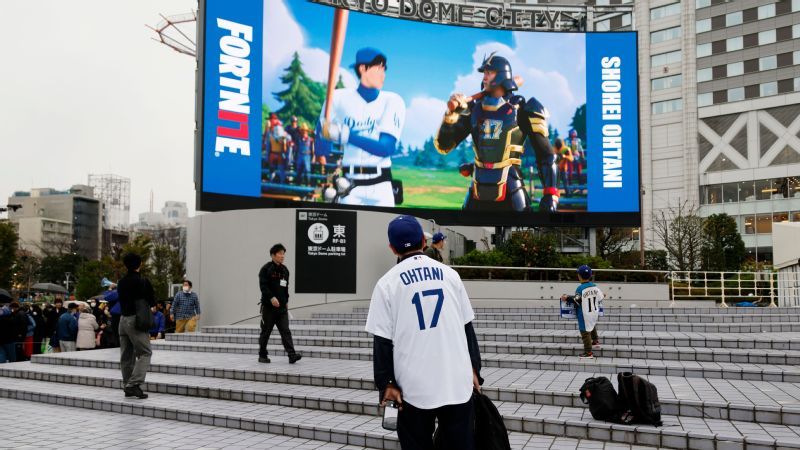
I have seen Ohtani on television, with the apron, prepare and eat a bowl of ramen – considering the onion – in an advertisement of something related to the food that has been mixed with everyone else. Relaxed but precise, it is one of your best jobs. I have seen him standing on a beach killing a soccer ball for those of green tea, smiling as if he did not know that they are filming him. I have seen him transform from Ohtani Dodger to Ohtani Samurai in a Fortnite ad, and it is difficult to say which of the two is more imposing. The television ohtani is a tacit presence in an advertisement of t -shirts with the image of an artist from his dog, Decoy. (Someone out there, apparently, intends to transfer the limits of fame).
Do not confuse the television Ohtani with the taxi television ohtani, which seems to run in an endless loop of rear seats. The first day that the teams practiced in Tokyo, a huge screen in front of Tokyo Dome issued a mixture of ads starring Ohtani interspersed with some promotional ads of the series, and a long line of people stood next to it, pointing with their phones to the screen.
“It is impossible to exaggerate Shohei in Japan,” he says Andrew FriedmanPresident of the Dodgers. “We believed to understand it, but until you see it and live it, you can’t understand it at all.”
Ohtani behaves as if he were aware that all the eyes of all the rooms are hyperfocalized in him and only in him. Here, in his native country, it is where that truth exceeds the limits of exaggeration. It has existed here for seven years as a mere figure on a screen-many, many screens-and yet its presence is never beyond the corner of a street. Baseball fans plan their summer days around the Los Angeles Dodgers matches, most of which begin late in the morning. It seems more fame than any human being is able to contain.
“Every time I go to Japan,” says Friedman, “I think, ‘Well, Shhehei, I haven’t missed you at all. I see you everywhere.”
Ohtani’s mother, Kayokohe takes care of his businesses in Japan, and it is clear that he is taking care of him. It is said that it is judicious when choosing sponsorship agreements, but it is difficult to imagine that it rejects many.
All this highlights the value of Ohtani, not only for itself, but for baseball in general and for dodgers in particular. For six days, Tokyo was a huge ATM. The MLB installed a 30,000 square feet store in the Tokyo Dome to sell items from the Dodgers and the Chicago Cubs, from cookies with the printed logo to Ohtani towels. (Topps set up an exhibition of four -storey baseball cards in Shibuya, just around the corner of the three Ohtanis. It included two Ohtani donations: the base that stole to complete its 50/50 season last year and a bat that it used during the World Series. Its agreement with Topps reported some 7 million dollars only last season, according to a source of the company It is relatively new in Japan.
Japan Airlines has a thematic aircraft of Ohtani, with his face in triplicate on both sides of the fuselage, and travel agencies throughout Japan organize trips so that fans travel to Los Angeles to see Ohtani play. The food stalls and the signage of the Dodger Stadium look very different from the two seasons. And annual revenues from Ohtani sponsorships, estimated at 65 million dollars in 2024 – the largest amount of any baseball player, and around 58 million dollars more than the second classified, Bryce Harper – made much more appealing for him to postpone almost all of his contract of 700 million dollars, which is partly responsible for Friedman’s capacity to spend what he wants (more than 300 million dollars) want
Ohtani’s fame is such that it can be imprisoning. He maintains a dispute with Fuji TV in Japan after it overwhelmed with a drone the house he bought in Los Angeles and broadcast the images. He rejected an interview with the chain after the Dodgers won the World Series. But rarely his fame has been as strong and implacable as when the Dodgers plane arrived at Haneda airport on March 13. Around 1,000 Japanese fans gathered in front of the customs to take a look at Ohtani, but the airport had installed white walls that served as a tunnel to separate the players from the public, so Ohtani’s followers had to settle for breathing the same air.
“It is a shame, but it is a matter of security,” he says Atsushi Iharaexecutive and former director of Nippon Professional Baseball. “If Ohtani left his hotel and walking down the street, he would end up being a police issue”
The scene in the Tokyo Dome and its surroundings for the four exhibition games and the two regular season is probably better described as a controlled civil chaos. Four hours before the first launch of the opening day, the crowd was so dense in the commercial areas outside the stadium that it was difficult to move, which was fine for most people, since they were happy to stand in groups and raise their phones to take videos of Ohtani’s last announcement that was broadcast on the huge screens around them.
(Within the Clubhouse of the Dodgers, a space with all the charm of an institute wardrobe, the highlight was a capsule for smokers similar to a telephone cabin, with a target on the wall that indicated the smokers where to point to get maximum ventilation). No Dodger seemed interested in using it).
Prior to each launch to Ohtani, it seemed as if the whole place contained the breath before releasing it in a massive exhalation. The result was irrelevant: Foul, swing … the answer was the same. And when Ohtani hit a home run in his second appearance in Tokyo, sending the ball at a half height of the right stands against the Tokyo giantsa group of mothers with their small daughters, all with Ohtani shirts, danced on the esplanade.
After the game, he asked Shinnosuke Abecoach of the giants, if he had had the opportunity to speak with Ohtani. “Yes,” he replied. “I saw him in the batting cage” pauses, as if he were deciding whether to move on. “You may not like this,” he said, “but I asked him if he could take a picture with him.”
There were five Japanese players in Tokyo’s series, but sometimes it was difficult to distinguish them. The Dodgers pitcher, Yoshinobu Yamamoto, from time to time in the ads of the train stations of an energy drink that, according to sources on the ground, was initially directed to the medium -sized Japanese employees and their rigorous schedules. Yamamoto’s task, along with his partner Ichiro SuzukiIt is apparently to recruit the younger Japanese consumer to experience the joys of the concentrated caffeine.
But in reality, there is Ohtani, always Ohtani and apparently alone Ohtani. “It is difficult to imagine it more famous than it is in the United States,” says Dodgers’ rookie Jack Dreyer, “but, without a doubt, it is the case” in Iwate, Ohtani’s native prefecture, at the northeast end of Honshu, passed ahead of a gas station with a row of tires of tires covered by canvases with the photo of Ohtani. A close sign declared: “More than 300,000 tires sold.” It was not clear if the seller was Ohtani or the gas station.
“What he is getting and what he has already achieved is something taken from a comic,” says Ihara. “As a comic superhero, one would think that no one can do things like that in real life. It is showing us that there are no limits to us as human beings and that is the inspiration that provides us continuously.”
Ohtani played four games in Tokyo, two who counted and two that did not, a distinction that did not seem to import. I was here, in flesh and bone, playing baseball in Japan for the first time in eight seasons, and provided enough memories – his thunderous home run at Wednesday’s fifth entry is the first one that comes to mind – to remember everyone why they came. And then he returned to his new life, to be an image on a screen or on an vending machine or on top of a store, not to be anywhere already be everywhere, somehow both at once.
