
NBA: Important lessons from the first weekend of playoffs
A strategy for a 25-year-old LeBron in LA, a new defense in Cleveland and a message from OKC: what we learned from the start of the playoffs.
In March 2000, LeBron James played what, until then, was the most important match of his life: the final of the Ohio state championship.
The tall freshman made 10 of his 12 field goals, grabbed nine rebounds and scored 25 points, giving more than a sign that he was destined for great things. However, the decisive player of the game was a freshman teammate of his named Dru Joyce, who scored seven three-pointers. His shooting display dismantled the opposing team’s zone defense, the first of many strategies devised to try to stop James.
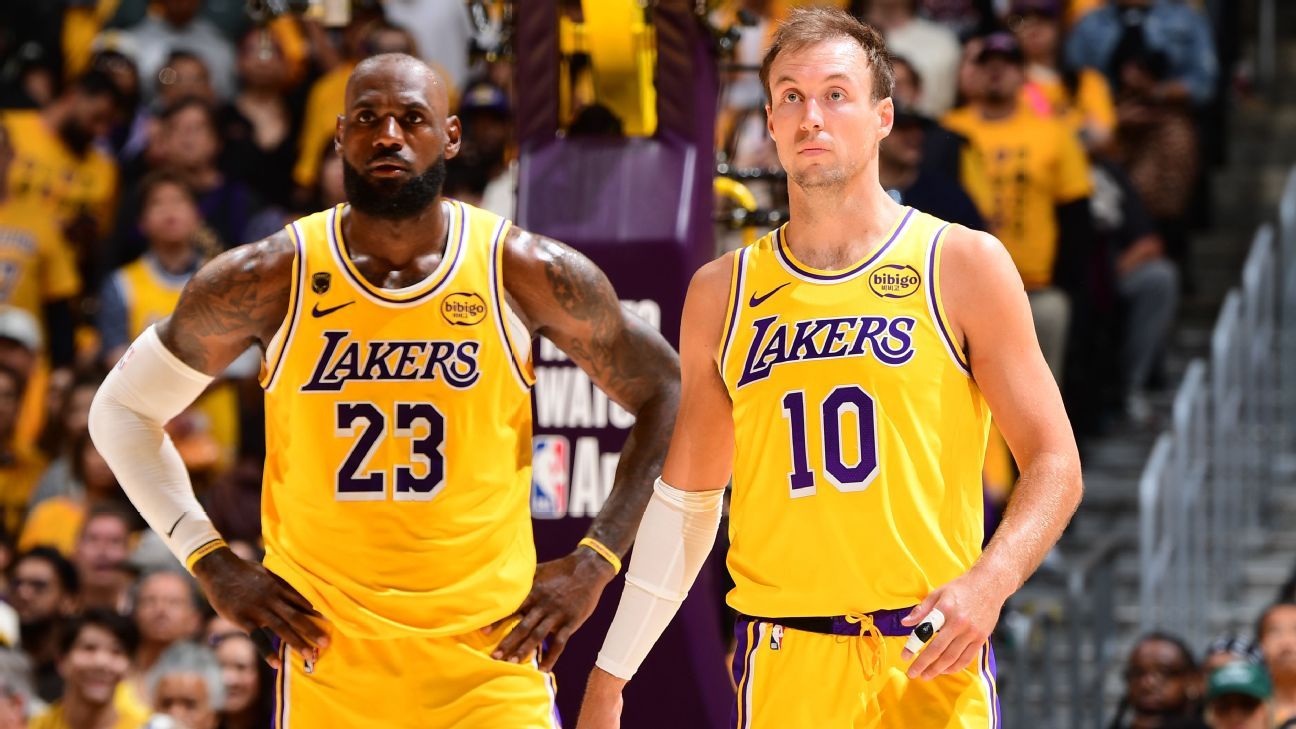
Luke Kennard He was then three years old. Fifteen years later, he surpassed James’ all-time scoring mark in Ohio high school basketball. The fact that Kennard made five 3-pointers and scored 27 points in the Lakers’ victory over the Houston Rockets in the first game of the series, played on Saturday, served as a reminder that, 26 years later, history has not changed much.
Over the decades, faces have changed, but this devastating strategy continues to work wonders. When the stakes are high, the formula is to give the ball to James, open the floor and win with him directing the offense, while the snipers open up around him.
It’s a playoff lesson that has endured throughout nearly two decades of James’ illustrious career.
The list of players who changed the course of playoff games with a barrage of triples, playing under James, is extensive: Damon Jones, Daniel Gibson, Wally Szczerbiak, Shane Battier, Mike Miller, Matthew Dellavedova, JR Smith, Kyle Korver, Danny Green and Kentavious Caldwell-Pope. Just check the statistics and match summaries; Even that meeting in 2000 is available on YouTube. Most of these shots were generated from direct assists from James, his “hockey assists” (pre-assist passes), blocks, or simply the attention he garnered by drawing in multiple defenders.
It is a situation similar to what was experienced on Saturday in the first game of the series, when James once again established himself as the facilitator par excellence, distributing eight of his 13 assists in the first quarter alone.
“He showed great leadership from start to finish,” Lakers coach JJ Redick said of James. “All week we talked about the importance of staying connected offensively and trusting the pass. He was the one who guided us.”
One of the most important lessons from the opening weekend of the NBA playoffs is now a quarter-century old: If you give James a shooter (or three) and the ball, his team is still capable of winning big games the old-fashioned way.
Below, we review some other lessons we have learned from the start of the eight playoff series:

The Cavs revealed a new defensive strategy… and it worked
The Cleveland Cavaliers They struggled defensively for much of the second half of the season. In addition to their injuries – which prevented them from acquiring rhythm of play; Coach Kenny Atkinson used 24 different players and 41 different starting fives—his defense ranked 15th. After all, it was a cause for concern ahead of their entry into the playoffs.
However, in their victory in the first game of the series against the Toronto Raptorsthe Cavs deployed a disciplined and solid game plan, focused on neutralizing the Raptors’ leading scorer: Brandon Ingram.
During the regular season, Ingram averaged 20 shots per game against the Cavs – the third-highest figure recorded against any team in the Eastern Conference – clearly establishing himself as the Raptors’ preferred option in their matchups against Cleveland.
On Saturday, the Cavs — starting with their primary defender, Dean Wade — guarded Ingram closely from the start of each possession. East finished the game with just nine shot attempts, and only one in the second half. He went to the free throw line 10 times; However, the Cavaliers not only prevented him from scoring, but made it difficult for him to even receive the ball.
Toronto was not helped by the fact that its starting point guard, Immanuel Quickley, was absent due to a right hamstring injury; In addition, the Cavs exercised a lax mark on his replacement, Jamal Shead who scored five triples. However, the Cavs were extremely pleased that he took two more shot attempts than Ingram himself.
“They tried to deny me the ball every time I went down the court,” Ingram said. “They obviously knew most of the plays we’ve been running all year… We have to figure out how to make the necessary adjustments for the next game and prevent that strategy from being so effective.”
The Cavs also slowed down the pace of play, a tactic that will be part of their game plan throughout their playoff run. Cleveland already ranks as one of the teams with the slowest pace of play in the league—being James Harden a determining factor in it—and Toronto barely managed to score three points on the counterattack.

If you lose the turnover battle in OKC, it’s all over
The Thunder had to win Games 7 last year on their way to the title, but that fact overshadows how truly dominant they were at home last spring.
Their average margin of victory at home during last year’s Western Conference playoffs was 29 points. Including the playoffs and the NBA Cup, they have a record of 149-40 in the last two seasons, despite having suffered significant injuries.
And after beating the Suns by 35 points in Sunday’s opener, the Thunder’s average margin of victory in first-round home games over the past two years is… 35 points.
Oklahoma City turned out intimidating on sunday. The Suns looked fatigued after playing a third game in three different cities in the span of six days against a rested Thunder; However, the efficiency of their performance illustrated what it will take to beat them four times in a single series.
The most important statistic under the radar this weekend might have been the fact that the Thunder edged out the Suns by 34-2 in points scored off turnovers. This may seem like a mere byproduct of a routine beating, but it is a true indicator of the Thunder’s level of play.
The team is built around Shai Gilgeous-Alexander and his dominance in the midfield; However, his philosophy is encapsulated precisely in those points generated from the rival’s losses. The Thunder are designed and programmed to win the possession battle. That is why they anticipate passing lanes, become obsessed with taking care of the ball and recruit athletes with long arms.
Get hold of the ball. Whether through a rebound, a steal, a split ball or a deflection; the method is irrelevant.
Watching the Thunder rotate 11 players during the first half — all of them executing near-flawless defensive rotations, creating eight steals and several additional deflections, and scoring 21 points off turnovers in just 24 minutes — was an eye-opening experience; both for the Suns and for anyone who dared to analyze the competition.

The Pistons’ weaknesses were exposed
Throughout the regular season, the Pistons continued to receive mixed praise.
They are an extremely tough team, both physically and mentally, but they have limitations in their ability to generate offense. Cade Cunningham and Jalen Duren They should feature prominently on NBA award ballots after their spectacular performances on both ends of the court throughout the season; However, it is difficult to aspire to great achievements with such discreet performance in the three-point shot.
Detroit was the only one of the eight local teams that, during the opening games of the weekend, ended up suffering a defeat; For their part, the Magic managed to maintain the momentum generated by their impressive play-in victory to claim Sunday’s victory. Cunningham looked at all times like the All-NBA First Team player who will most likely end up being named, recording 39 points and gallantly trying to carry the weight of his team to lead it to victory.
Cunningham took 27 shots, and only one of his teammates managed to reach double figures in shot attempts: Tobias Harris who had a disappointing performance by converting just 5 of his 15 attempts. Duren, who had emerged as an offensive force during the final stretch of the season, could barely make four shots and was outmatched by the Magic center, Wendell Carter Jr.
The Pistons were a poor 4 of 16 on shots generated from Cunningham’s passes; Likewise, the bench players were a combined 4 of 16 in their shots. In terms of three-pointers, the team was 10 out of 32, a figure that was even one triple below their season average (11 per game), which placed them in 28th place in the league.
As a team capable of reaching 60 wins, the Pistons have enough quality to make the necessary adjustments for the second game; However, in a day in which teams like the Thunder, the Spurs and the Celtics lived up to their position in the standings, the traits that have made the Pistons look vulnerable for months were blatantly manifested.

Victor Wembanyama is not afraid of this moment, or any other
The 22-year-old got off to a strong start, scoring 12 points in the first quarter of his first playoff game, and added 21 of his 35 points in the first half of the Spurs’ win over the Blazers in the series opener. His overall statistical line was more discreet than usual, if we compare it with his own extraordinary standards: he registered just five rebounds, one assist and two blocks.
How does this compare to the first playoff games of some of the recent big names? In short: pretty good.
James’ first playoff game was also extremely impressive, posting a triple-double of 32 points, 11 rebounds and 11 assists in an 11-point victory. However, that type of performance — as well as leading his team to victory — is rarely the norm.
Kevin Durant He scored 24 points in his debut, but made only 7 of his 24 shots in a loss. Stephen Curry He added 19 points and nine assists, also in a lost game. Luka Doncic He was exceptional in his first playoff game in Dallas, scoring 42 points, capturing seven rebounds and distributing nine assists; However, the Mavs were also defeated. Kobe Bryant He played just 46 seconds in his first playoff game, when he was a rookie with little prominence. In his first playoff start—during his third season, like Wembanyama—Bryant recorded 17 points and made the free throws that sealed the victory.
Shaquille O’Neal — to whom some have compared Wembanyama due to his precocious dominance at the center position — added 24 points and 19 rebounds in his first playoff game; a match that, like the previous ones, ended in defeat.
