
Key meeting in F1 amid drivers’ concern
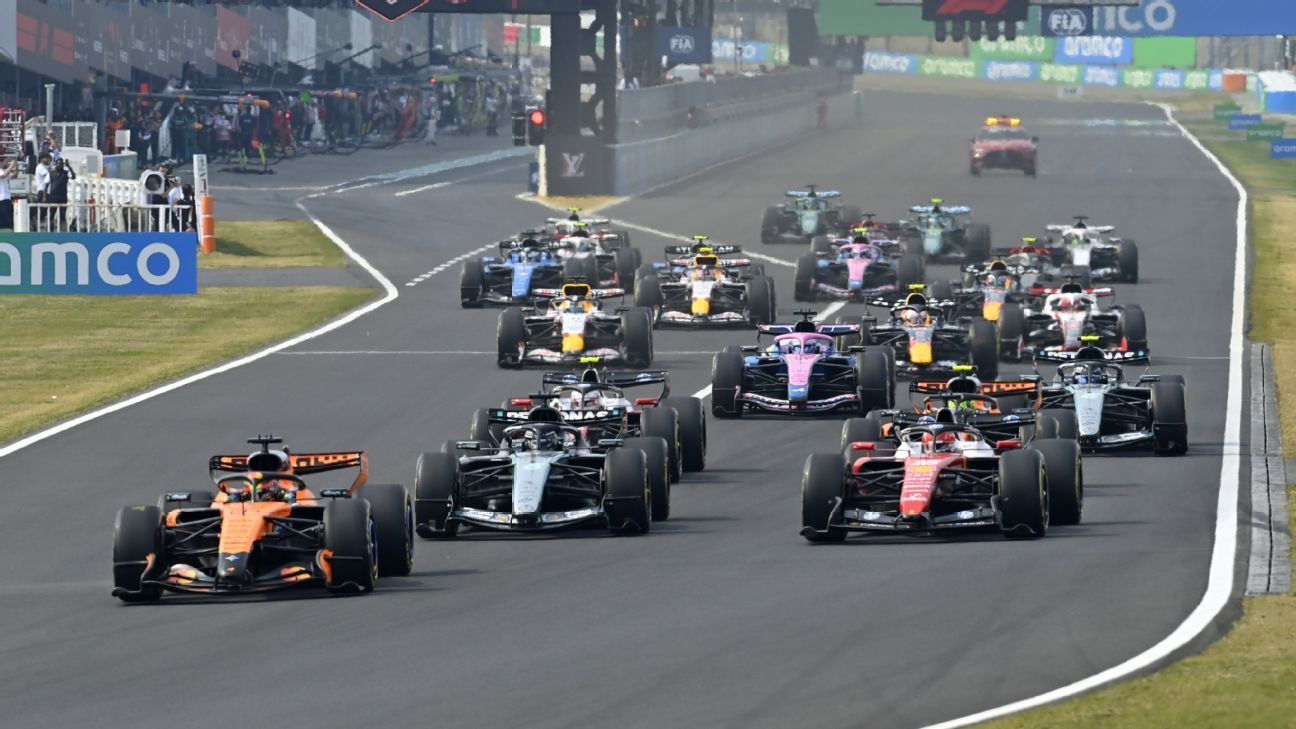
FIA, FOM and teams will have a meeting to discuss changes in the technical regulations. The substantial points are safety, after Ollie Bearman’s accident behind Franco Colapinto, and improving the handling of the cars.
“The chat is really exploited. Rarely has everyone been involved like now. “The pilots are proposing solutions to the regulations,” said Alexander Wurz, former driver and president (since 2014) of GPDAthe Grand Prix Drivers Association for its acronym in English. The Austrian, who competed in 69 races in Formula 1 between 1997 and 2007 (achieved three podiums), thus referred to the continuous chats that are taking place these days between the racers in the WhatsApp group. Because, yes, just as each person has their own name for their job or their study group, there is one that includes Max Verstappen, Lewis Hamilton, Lando Norris, Franco Colapinto… And the signatures continue. There is also Wurz, as president of the pilots’ union. One thing is clear: there is concern with the new regulations and that increased considerably after Ollie Bearman’s beating in Japan.
The new technical regulation forces pilots to take care where they previously risked, to lift his foot off the accelerator where it was previously stuck to the floor and to perform maneuvers that were not included in his personal task. Although F1 has always been a risky sport (like all motor sports), these days the danger in the top category has increased, because it may happen that two cars are on the track in different energy phases and that implies an abysmal difference in speed. And it happened in Japan, when Bearman arrived with his Haas with full energy on the straight before Spoon and found Colapinto’s Alpine in the middle of recharging. The almost 50 km/h extra speed that the Englishman was driving forced him to make an evasive maneuver to avoid the Argentine, he stepped on the grass and, uncontrolled, ended up against the wall in a 50G impact. The image of Bearman limping after the impact was frightening.
To safety, the most important issue without a doubt, is added the manifest disagreement of the majority of pilots with the way of driving. To recharge the battery, which is not enough for the entire lap, they must resort to super clipping, that is, recovering energy with full throttle in fast corners so that the high revolutions feed the MGU-K, therefore, that power does not travel in its entirety to the wheels. Thus, cornering in fast variants (like Suzuka’s 130R, for example) today is done at 40 or 50 km/h slower than until last year. And they must also perform lift and cost, that is, lifting the foot off the accelerator a handful of meters before the end of the straight to manage battery consumption.
Added to the combo is the displeasure on the part of the public that is expressed on social networks.. Although the three Grand Prix contested so far (Australia, China and Japan) were with full stands (Shanghai had record attendance), television audiences in Europe fell in most countries. In Spain it fell 49%, France 43%, Germany 21% and Austria 36%. The other side is Italy, where the impressive start of Kimi Antonelli, World Cup leader, raised the numbers by 36%.
All this was taken note of and Next week (Thursday the 9th of this month) a meeting will be held between F1, FIA and teams, as confirmed by The Race site. The agenda of the meeting will have three points: reduce the risk of accidents due to speed differences, ensure that the classifications are at their maximum again and avoid sudden drops in speed at the end of the straights. There will be six possible solutions on the table.
Currently, the regulations allow 250 kw of energy to be recharged with full accelerator, making the super cut in the engine to power the MGU-K, out of the total 350 kw that the electric motor has. At the meeting it will be proposed that recovery be allowed to be raised to 350 kw in super clipping and in this way lift and coast will be reduced, that is, lifting the foot off the accelerator at the end of the straight, because the pilots will not have to take as much care of energy. This will avoid brutal speed differences on the straights.
Slower cars
In qualifying, drivers can no longer win that tenth with courage, as Fernando Alonso said in Japan. You can no longer seek the limit in a curve by braking further than your rival because you have to take care of energy management. To once again allow the skill and courage of the runners to have an impact on a classification, The proposed solution will be to change the power deployment and extend the use of the electric motor on the straights. The maximum power would remain at 350 kilowatts, it would make the cars run slower, but the definition would be more in the wrists of the person driving the cars.
Reduce recharge limit
Lowering the amount of recoverable energy per lap may be a definitive solution, but Formula 1 will have to accept having slower cars. The 2026 regulation allows a maximum of 9 MJ of recovery per turn. In qualifying, Suzuka was lowered to eight with the idea of giving the driver more chances, but it didn’t help much. Lowering to 6 MJ per lap at all times is being evaluated so that riders can reach the recharging limit more easily and should no longer do as much lift and coast. F1 carefully studies the point, because if it were lowered from nine to seven, the cars would be one second slower per lap and if it was lowered to six, they would reach a total loss of two seconds. But the gain would be that, with those slower cars, the drivers would go to the limit, something that does not happen today.
Free active aerodynamics in qualifying
In 2026, DRS was removed and active aerodynamics was applied. That is, the pilot’s ability to open and close the wings, both front and rear, to be in straight mode or curved mode. When the wings open, the drag (drag) can drop by up to 40% and this reduces the need to use engine power. The straight mode (open wings) in current regulations can be used only in the areas determined by the FIA on each circuit. In order to improve the rankings, The possibility of releasing this straight mode during qualifying is being evaluated and it is up to each pilot to decide when to activate it. Something similar happened with the DRS in 2011 and 2012, years in which it was free to use in classification.
Reduce electrical power
When the 2026 technical regulations were written, the engine section indicated that all of the engine’s power would come from combining the combustion impeller and the electric impeller in equal parts. However, at this moment the balance is 55% of the thermal and 45% of the battery (400 kw and 350 kw respectively). In the pipeline is the idea of further reducing the impact of the electric motor on the power unit and increasing the combustion engine. Raising the fuel flow would be enough to improve the power of the thermal, but raising the speed could lead to reliability problems because power unit builders They designed the combustion system using components that respond to the regime written before the start of the World Cup. This solution could generate multiple breaks. Therefore, this item will be discussed, but by 2027.
Simplify the rules
This points to two questions: that the general public understands more easily what they are seeing and that the drivers do not get involved in strange problems in the cars. So that people watching the race enjoy seeing a car pushed to the limit and that the driver can do it and not have everything determined in software. It was precisely a software failure in the Red Bull Ford Powertrains power unit that caused Max Verstappen’s mistake in qualifying in Australia. An error arose in reading software data on engine speed and transmission movement to the rear axle when downshifting. To counteract the abnormal number of revolutions, the system entered safe mode and this generated the intervention of the engine brake, which, as a result, blocked the rear axle. Simplifying all this confusion would be to the liking of drivers and teams, fundamentally.
