
World Baseball Classic: Can the restriction on pitchers improve?
There are two obstacles in the World Baseball Classic, surrounding pitching, that prevent the tournament from reaching its full potential
MIAMI — The ninth inning came with the score tied after a Bryce Harper hit seemed to wake up the United States, a change of momentum that heralded a championship.
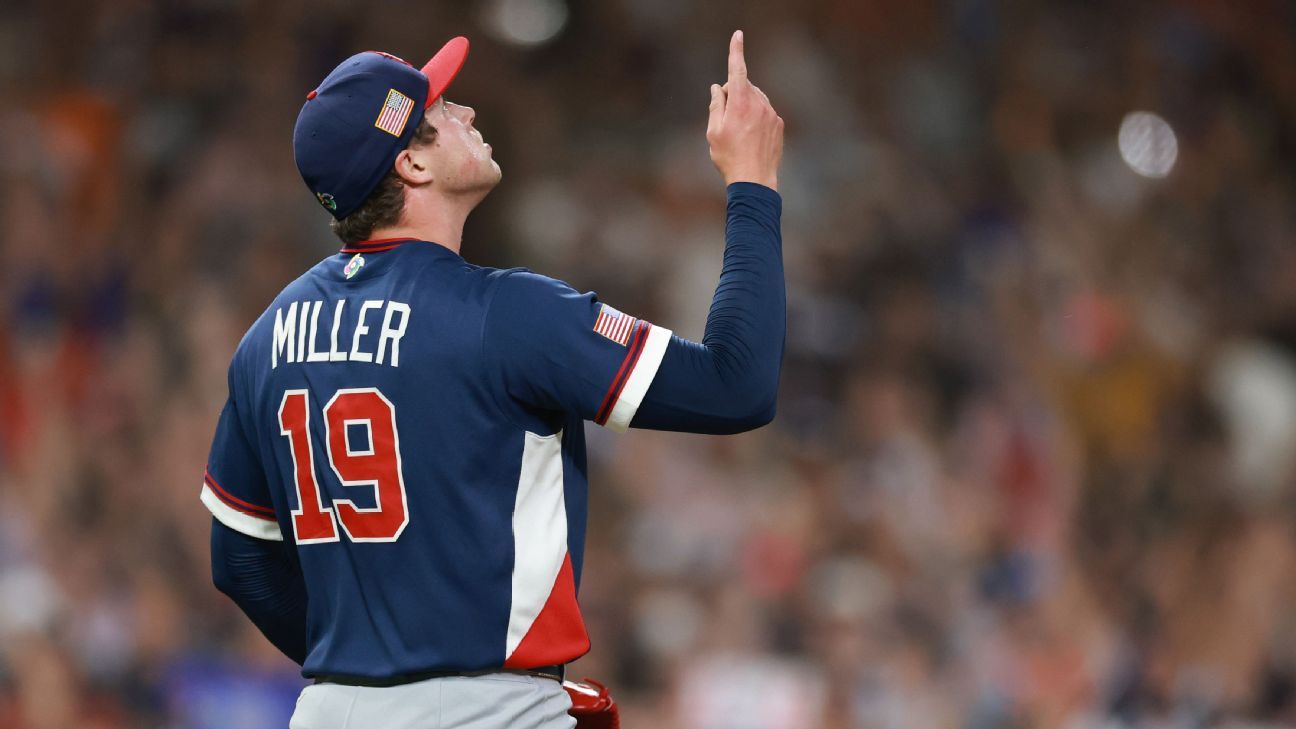
The United States needed three outs to have their turn at bat and a chance to win the game. But Mason Miller, the best closer in the world, remained out of work.
In this situation, with no save opportunities, Miller would have been the obvious choice to pitch in the top of the ninth inning. In fact, not using it would have been negligent. But even for it to be available by the end of this World Baseball Classicit was necessary to convince him. Miller had pitched twice in the previous five days. The San Diego Padres, who will rely heavily on him over the next six months, told the American team that they only wanted him to pitch if absolutely necessary, which, in this case, meant a save situation. So Miller watched from the bullpen as Garrett Whitlock allowed the winning run.
“A tribute to the Padres,” said the manager of the United States team, Mark DeRosafollowing his team’s 3-2 loss to Venezuela on Tuesday night, when asked why Miller didn’t pitch. “If we had taken the lead, he would have gone in. But I wasn’t going to have him pitch with the score tied.”
He World Baseball Classic (WBC), which has just concluded its sixth edition, has reached undeniable levels of popularity. Fans from all over the world are very involved. Players, even those born in the United States who previously had difficulty understanding the importance of international competition, have become fully engaged. However, two obstacles continue to prevent the WBC reach your maximum potential.
One is the increasing difficulty in securing contracts and the number of players who did not participate for this reason. The other is the use of pitchers who would otherwise be in spring training preparing for the Major League regular season, and the constant concern of team management about their health. No one knows this better than those who have been in charge of communicating with them in recent weeks.
“They bombarded my phone with all their restrictions,” lamented a coach from the World Baseball Classic.
The manager of Venezuela, Omar Lopezfelt those restrictions the morning of the most important game of his life. Lopez had relied heavily on his bullpen to defeat Italy on Monday night and woke up Tuesday morning to text messages from three different teams imploring him not to use his relievers for the second night in a row.
“Dear God,” Lopez said to himself, “here we go again.”
López was on the verge of delivering a championship to Venezuela, a baseball-obsessed country undergoing unprecedented political turmoil and clinging to its national team like never before. What was at stake was unimaginable. But suddenly obstacles appeared from people who didn’t care at all about international competition.
“What’s wrong?” asked López’s wife. “Same s—,” he replied.
López put his head back on the pillow to collect his thoughts and made a decision.
“You know what?” López recalled saying, “I’m going to answer these people. I’m going to fight for these players.”
For many of the players and those around them, this tournament has come to mean as much, or even more, than their seasons in the Major Leagues. The future member of the Hall of Fame, Albert Pujolsspoke openly about how coaching the Dominican Republic during this year’s tournament was the best baseball experience of his life. Roman Anthony and Gunnar Henderson, at the beginning of their careers and with promising futures, stated that they would take advantage of every opportunity to play in the World Baseball Classic. Tarik Skubal, a free agent about to sign the largest contract in history for a pitcher, was visibly undecided about whether to start a game for the United States team again. Even before winning the championship for his country, Ronald Acuna Jr. declared that this is more important than anything he achieves in the Major Leagues.
“I love Atlanta very much, but before playing in Atlanta, I was born in Venezuela,” Acuña said. “Venezuela made Ronald Acuña Jr.”
Eduard Bazardo of the Seattle Mariners, Angel Zerpa of the Milwaukee Brewers and Daniel Palencia of the Chicago Cubs played their second consecutive game with Venezuela, coming in as relief for a very effective Eduardo Rodriguez. Together, they neutralized a powerful United States lineup and led Venezuela to its first championship of the year. World Baseball Classic.
Viewership numbers for that game, broadcast on FOX, have not yet been released, but even without them, this year’s tournament has featured four of the five most-watched games in the game. WBC and six of the nine most watched in the United States, according to the MLB. The highly anticipated semifinal between the United States and the Dominican Republic averaged a record 7.4 million viewers, despite not having been broadcast on open television. The final is expected to exceed that figure.
He World Baseball Classic set an attendance record of 1,306,414 spectators in 2023; This year it surpassed it with 1,619,839. Until the semifinals, social media posts from the official MLB, MLB en Español and World Baseball Classic accounts generated more than 2.24 billion views worldwide across all platforms. The growth in popularity of the tournament seems to have paralleled the enthusiasm of the players.
How to make your availability respond to that enthusiasm, in a way that satisfies teams and agents with competing interests, remains an unknown. One possibility that has been considered is a change of dates, which could be tested in 2028.
The Summer Olympics will be held in Los Angeles that year, spurring a major campaign to get Major League players to participate. If this comes to fruition, the MLB would extend its All-Star break to accommodate it. The participation of star players, particularly from the United States, Venezuela and the Dominican Republic, the three teams from the Americas that have already qualified, will probably be similar to that of the WBC. The circumstances of the Olympic Games could also serve as a model for the World Baseball Classic move your tournament to mid-summer.
“As baseball continues to evolve, we have talked about midseason tournaments in general,” stated MLB commissioner, Rob Manfredto The Associated Press, on Wednesday. “And certainly, if we decided to get serious about the idea of a mid-season tournament, this would be an ideal opportunity.”
Whether this will affect pitcher usage remains an unknown.
DeRosa, for example, thinks so.
“They would be better prepared and more focused, and we would have to deal with a lot fewer restrictions and guidelines for pitchers if it were moved midseason,” DeRosa said. “Without a doubt.”
Some coaches, players and agents consulted by AM850 They agreed, noting that the starting pitchers would be in top shape by then and would not have to meet specific goals with the regular season just around the corner. Others objected, pointing out that the pitchers would be much less fresh by then and that the fears of their teams — not to mention their agents — would not go away.
“They don’t see any advantage in this,” said an official from the WBC about the teams that saw their pitchers participate in the tournament. “They only see disadvantages.”
It’s understandable. Teams pay players for their services during the Major League season. Working somewhere else can only hinder your ability to do so. That dynamic will never change. For pitchers, circumstances will always be more delicate. And while teams cannot prevent their players from participating in the WBC —as long as they are healthy and their contracts are valid—, nothing prevents them from dictating its use in it.
This year, it meant that Shohei Ohtani only batted for Japan. It meant Skubal only made one start, against an inferior Great Britain team, for the United States. It meant that Luis Castillo was not present for the Dominican Republic. This meant that Jose Alvarez, a veteran left-handed reliever who hadn’t played in the majors for three years and had recently been pitching in an amateur league, had to be included on Venezuela’s roster.
It meant that, in the most important moment, Mason Miller could only be a spectator.
