
NBA Finals 2025: How to quantify the growing art of tracing
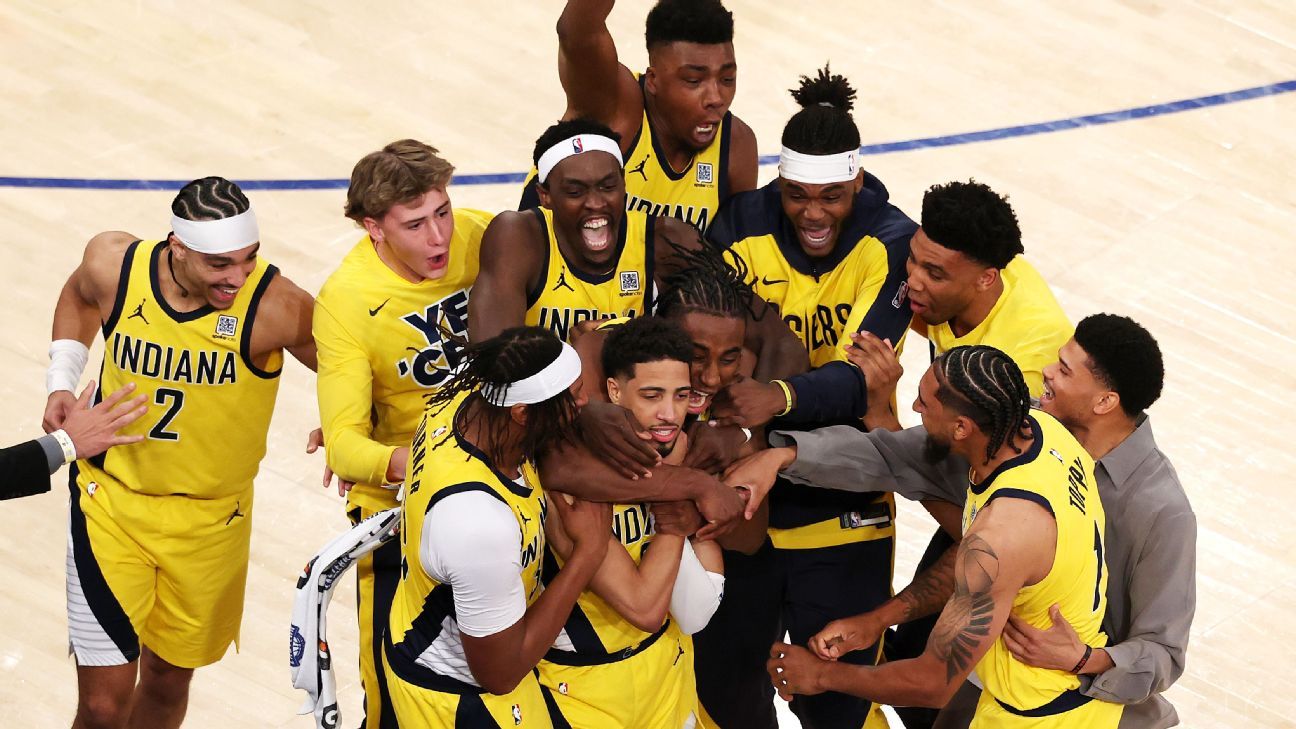
They are not surprised to see an important comeback in the NBA finals. Because no one dominates art like the Pacers, the Eastern Champions.
The Playoffs of the NBA of 2025 have been characterized by the comebacks, and no one has dominated this art such as the Indiana Pacers, champions of the Eastern Conference.
The Pacers traced a disadvantage of seven points in the last 40 seconds of the extension to complete their 4-1 victory over the Milwaukee Bucks in the fifth match of the first round, and then achieved the same feat in the last 50 seconds of their victory in the second game over the Cleveland Cavaliers in the semifinals of the East Conference.
All this was the prelude to Indiana’s most unexpected play, the Houdini, in the first game of the Eastern Conference Finals. With 14 points against in the four minutes of the regulatory time and eight in the last minute, the Pacers used a burst of triple from Aaron Nesmith, inopportune losses of the New York Knicks and a high shot of Tyrese Haliburton on the horn to force the extension and, finally, steal the first game in the series. Inspired by the late comebacks of Indiana and the three victories in New York when I lost at least 20 points, the largest number of a team in a single playoff series in the era of the story played per play (which began in the playoffs of 1998), let’s see more closely how the comebacks have dominated the playoffs of 2025.
Are the Pacers the best comeback team in the history of the NBA playoffs?
The short answer, limiting it to the period in which we can really quantify the comebacks, is almost certainly. The long answer, quantifying this title, is complex.
No one has worked so much on the probability of victory and the comebacks as Mike Beuoy, of Inpredictable.com, an excellent NBA resource. The website classifies each match with a comeback score according to the probability that the winning team reaches the lowest point, and the three unlikely victories of Indiana are among the seven best comebacks of the playoffs since 1997.
Inpredicable.com also analyzes the average removal score for each team victory. (Technically, it is about the geometric average, which weighs an atypical comeback with less intensity than the traditional average). Despite this adjustment, it is still easier to build a high removal score with less comeback than with as many as the Pacers (and the Knicks) have had so far. By graphing the average of each team in the playoffs since 1997 against their victories (with this year’s teams highlighted by the main color), it is evident that Indiana and New York are atypical equipment.
In collaboration with Beuoy, we try different methods to find a single removal method that considers both the volume of comeback and their improbability. The most satisfactory was to calculate the product of the probability of each victory at its lowest point, that is, the probability that a team will win all the games that it won in the playoffs.
This analysis considerably favors teams with the most victories in the playoffs, either by comeback or not, since no match has a 100 % probability from the beginning. However, the 12 victories of the Pacers (and continue to add) occupy the second place since 1997 in this group, only behind the Dallas Mavericks, 2011 champions, which obtained 16 victories. In the table, Dallas has the highest aiming score among all title winners.
Meanwhile, the 10 Knicks victories occupy the seventh place, the greatest amount of any team before this year without reaching the finals.
Do Victoria’s probability models underestimate the possibilities of comeback?
Indiana’s three comebacks have seen the team victorious, after Victoria’s probability estimates gave 2.1 % or less likely to happen, including 0.9 % against New York. It is not exactly as if you were a lightning twice (the National Meteorological Service estimates that the probability that this occurs once is 0.000065 %, based on a useful life of 80 years), but it is extremely unlikely if it is based only on chance.
Based on this, some skepticism can be forgiven about the probability of victory. Part of the challenge is that these estimates are based on historical data that do not always keep up with the vertiginous evolution of the NBA. The AM850 model, for example, was created in 2017 based on training data of the approximately seven seasons. As the comebacks become more common due to a faster game rhythm and a greater volume of triples, a trend on which I wrote with Boxter Holmes of AM850 in 2019, we may be underestimating the probabilities to some extent.
The other problem is calibration. All models have uncertainty, but the difference between a 57 % and 58 % victory probability is irrelevant in most practical contexts. At the ends, uncertainty is magnified because a comeback with a 98 % victory probability is twice as probable that one with a 99 %. And a comeback with a 99 % probability (one between 100) is 10 times more likely that one of 99.9 % (one between 1000). Therefore, even small calibration problems are important.
Is there any statistics that quantify the good performance of the offensive and defense of the Pacers when playing so well?
There could be an explanation for this particular postseason to have seen so many comebacks, when most of the factors mentioned have been in force: the relationship between attack and defense. The attacks are usually somewhat more effective after a stop, since this allows more opportunities for an early attack and an exchange of plays in defense, but the benefit of a stop (or vice versa) can depend on various factors that vary from one team to another and from one season to another.
In general, these playoffs have shown a huge efficiency difference depending on whether the attack begins with a defensive rebound or draws the ball after a challenged basket. According to Inpredictable.com, their data shows that the equipment averages 1.17 points per possession after a defensive rebound, compared to 1.07 after a convented shot or a loss of ball to the stopped ball. (The average ball theft, or live ball losses, is much greater, with 1.23 points per possession). This represents a change with respect to the latest playoffs, when the difference according to the start type has been much lower: only 0.01 points per possession better in 2022 and 2023.
As for why this could have changed, it would point out the greatest physical demand allowed by referees in the playoffs of the last two years. Inevitably, physical demand is more important in situations of half court than in transition. During the Playoffs of 2023, when the whistles were stricter, the teams averaged 1.1 points by possession, more efficiently, after a scored shot or a loss of ball with dead ball.
I think this could explain why avoiding ball losses has been crucial in this year’s playoffs. As Owen Phillips of the F5 bulletin has been following, the team with less ball losses has had a 53-20 record (.726), which would represent the highest percentage of victories for this type of equipment in the same tie. Last year, teams with less ball losses won only 60% of the time, near the average of the last decade (62%). The winners of the battle for ball losses barely exceeded the .500 in the 2018-19 season (41-37).
It is more difficult to explain why the teams are scoring so efficiently thanks to defensive rebounds this year, although fatigue could be a factor, since the headlines of several teams that arrived at the conference semifinals accumulate many minutes. Focusing specifically on Indiana, the Pacers benefit more than most defensive rebounds teams. They averaged 1.26 points per possession after those rebounds, as unpredictable, the third best of the NBA. Although Indiana is still third after a scored shot or a loss of ball to a stopped ball, its efficiency falls into 0.16 points per possession, a figure higher than the average.
At the other end of the court, we observe a similar difference. The defense of the Pacers is the tenth better after a scored shot or a loss of ball to a stopped ball, and 0.17 points for worse possession after a defensive rebound, falling to the 14th place.
Now, what does this have to do with the comebacks? The greater the difference between the stops and the annotations at the other end of the court, the more likely it will be that a team (or a league) has gusts, since the magnitude of each possession is amplified. A stop not only prevents the opponent from scoring, but also enhances the team’s attack, and vice versa: a virtuous or vicious circle, according to the perspective.
The more streak it has a game, the more likely it will be that the teams build great advantages and that the opponents react. Summ it and you will have the recipe for Indiana’s comebacks. On the other hand, despite losing an advantage in the last quarter in the first game of his series against the Denver Nuggets and tracing a disadvantage of 26 points to rest against the Memphis Grizzlies, the Oklahoma City Thunder has not depended so much on his attack to succeed in defense.
Oklahoma City has defended very well after a convented shot or a dead ball loss (second in percentage by possession after the Detroit Pistons), but is allowing 0.08 points for possession less than any other equipment in possessions that begin with defensive rebounds.
