
How Freeman’s Grand Slam changed Dodgers fans
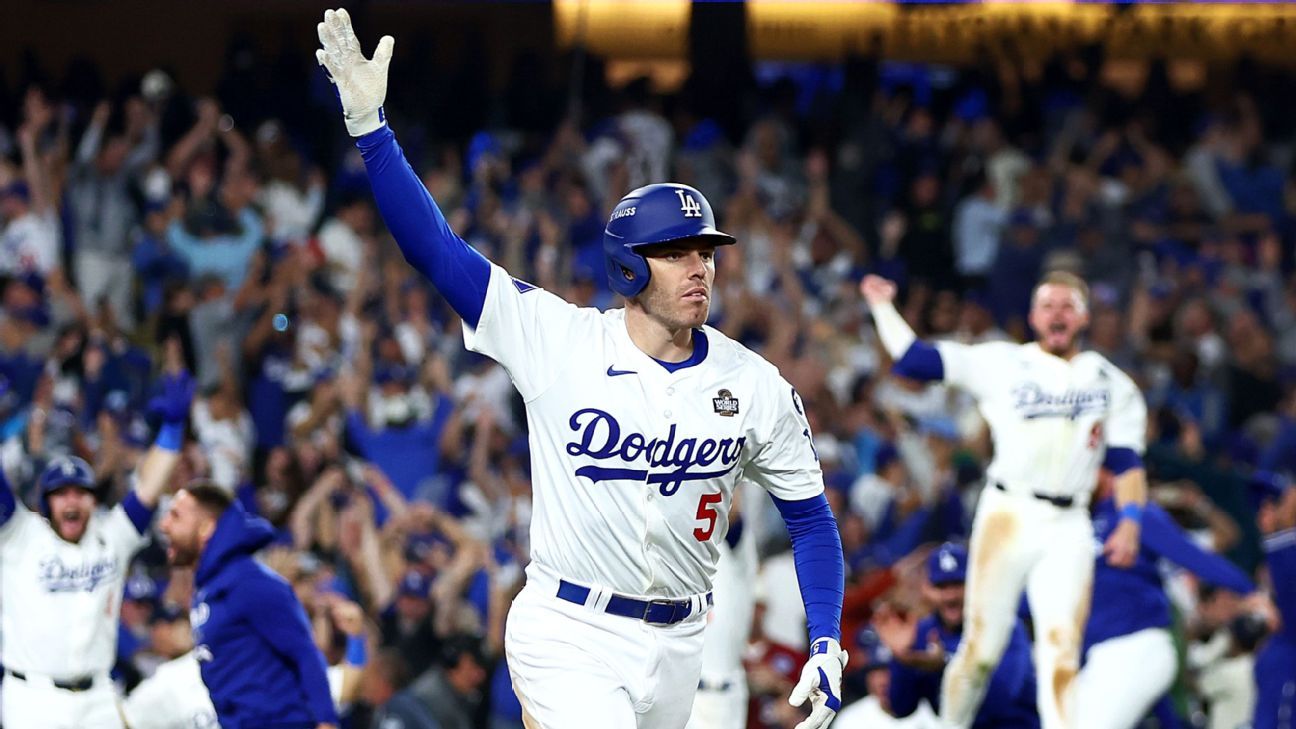
There are bobbleheads, t -shirts, tattoos … and even a fan, according to Freeman, who said he had not played a drink since then.
Los Angeles – The image of a triumphant Freddie Freddie October 25, 2024 -In the middle of a celebration, with the impassive face and the right hand pointing up- it has been tattooed in different parts of the body throughout the Los Angeles County. Freeman himself has signed four of them, three in the pimples and one in one arm. Before, I could go practically anywhere in southern California without recognizing him, even in the areas where he grew up. Now that never happens. The fans approach him everywhere and many tell him precisely where they were when he hit the Grand Slam that gave the victory to Los Angeles Dodgers in the first game of the World Series and helped them win the championship. Often they only say: “Thank you.”
“I’m glad,” Freeman said. “It means that something good has happened, right? You don’t try to get that moment, you just arrive and expect to be prepared for him. I have failed many times and nobody really remembers the failures.”
Freeman’s home run, the first of four in a world series in which he achieved an OPS of 1,364 and won the award for Most valuable playerhas been represented in innumerable bobleheads, t -shirts and paintings. It has been issued on the giant screen of the Dodger Stadium before each game at home and it is possible that it continues to reproduce there forever, just like the feat of Kirk Gibson 36 years before.
Freeman is hitting better than ever in his 35 -year -old season, even while fighting the same ankle injury that afflicted him in October. Somehow, it has been more productive in its 30 years than in its 20th. Reach 3000 hits, an almost unimaginable feat in an era dominated by the pitchers, remains a clear possibility. He Hall of Fame It is almost a certainty. But a swing in one night will eclipse in some way everything that Freeman has achieved, a reality that highlights the return of the Yankees to Dodger Stadium this weekend.
“And it’s fine,” Freeman said. “Something big happened to us when winning the World Series, and enjoyed every second.”
Freeman is as strict with his routine as any other athlete, but he is also sentimental. And while several of his teammates spoke at the beginning of the year about the importance of moving forward in the hope of avoiding a disappointment, Freeman wondered why he could not be both. In your opinion, you can savor an achievement while another prepare. He found himself looking forward to that moment, in large part because he has played enough to appreciate his uniqueness.
An interaction with a fan, which lasted three minutes, reinforced it.
Freeman was among a group of Dodgers players at a lunch on January 31 for those affected by Los Angeles forest fires; It was part of the annual tour of the team by the community. There, a man told how he stopped drinking the night of Freeman’s home run. Freeman remembers every detail of that conversation. The fan was sitting in the right field section and promised to stay sober to be more present for his two children. Freeman’s homer’s ball flew over his heads, and all his children wanted was to play baseball the next morning. Normally, the man told Freeman, he would be too compensated to accompany them. This time I had energy to play all day. The fan said he had not played alcohol since then.
“I get excited,” Freeman said when telling the story. “And you think about how not only baseball, but sports in general can influence such a positive way in the lives of people, that being able to be part of something like that is something very special. I love this sport. It helped me overcome difficult moments, as when I lost my mother and things like that; my father and I went out to play baseball, we did things together.
“Help. And when you close the circle 25 years later, when you are 35 years old and create a moment for someone … That is what all this means for me. I love winning and the championships, but knowing that I have been able to influence someone’s life in such a positive way … I still don’t know if I can understand it.”
When Freeman crossed the plate, the first thing he did was run to his father, Fred, and hit the five with him through the network behind the plate. Freeman’s mother died of melanoma when he was 10 years old. But Fred had also lost his wife. All his life put on top legs. Even so, he continued to be there for his children. Baseball became his therapy. The story of that fan made Freeman think about how these two children could be impacted by the fact that his father was also there for them, and in how a moment can have such a transcendental brand.
“The sport is great, uncle,” Freeman said, shaking his head. “You can do so many good things for so many people.”
Freeman had had difficulties during the first three weeks of the last postseason, while playing with a right ankle injury that had been made on September 26, the night when the Dodgers secured the pass to the first round, and with an injury in the ribs that suffered a week later. Towards the end of the National League Championship series, it was hard for him to keep his balance in the batting box. Any attempt to support the foot on the ground made him crooked. In the end, the defeat in the fifth match against the New York Mets was a blessing.
The MLB had introduced a change in the calendar of the postseason that allowed the World Series to start before if both leagues concluded their championship series in five games or less. The Yankees fulfilled, dispatching the Cleveland Guardians in the fifth game. But the Dodgers lost to the Mets, prolonging the series to a sixth game.
Freeman said: “That changed everything to me.”
Instead of having only three days off before the World Series, Freeman sat in the sixth game, saw how the Dodgers took the title and, when the Yankees arrived at Dodger Stadium for the first game, he had enjoyed six full days of rest. Suddenly, it was a more complete version of itself, agile enough to get a triple in the first entrance and flexible enough to hit Nestor Cortes in the tenth entrance, sending it to 413 feet and creating one of the most emblematic moments in the history of the postseason. The Dodgers won the series in five games.
“There are so many little things,” Freeman said, “and could have come out in many different ways.”
Freeman felt good enough after the World Series to think that the break would suffice to cure his ankle. Four weeks later, I could barely walk. The images revealed that four ligaments had broken. An operation was necessary. Freeman spent the next four months rehabilitated, but on March 30 he slipped into the shower, his ankle was injured again and had to spend a brief period in the list of injured.
In his first 11 games after his return, Freeman hit alone .250. His hips opened too soon and his swing did not remain in the Strike area enough time, the continuation of a mechanical problem he had worked during most of the previous year. But a single to the opposite field in the sixth entrance against Paul Skenes on April 25 unlock the feeling that Freeman had been looking for. Since then, he is hitting .412/.474/.647 in 31 games. His batting average of .368 and his OPS of 1,065 this season place him above all players except Aaron Judge. Its 186 weighted races created are tied with their best personal brand, established during the season shortened by the COVID-19, when MVP of the National League was appointed.
The Dodgers team, from which many expected the victory record in the regular season, currently has 14 pitchers in the injured list and has had to fight with nails and teeth to maintain a slight advantage over the San Diego Padres and the San Francisco Giants in the west division of the National League, with a 35-22 balance. Despite this, the manager of the Dodgers, Dave Roberts, believes that Freeman has reached another level of intensity.
“It’s very concentrated,” Roberts said. “It is not the relaxed intensity that it usually has, but a more nervous intensity.”
Freeman’s right ankle’s daily treatment has been reduced from up to four hours last October to just 40 minutes. He is much better, but the coaches have told him that he will not be completely recovered until after the break of the All-Star. Freeman continues to wear heels in the boots to relieve some discomfort. His first steps in the morning are still very painful. Dodgers do not let him steal bases, even when time favors him, a restriction that bothers him a lot. But keep performing.
Freeman is on its way to getting 7.1 victories above the replacement (AGRAPHS) this season, which would represent the second best total of his career. If you get it, it will occupy the seventh place between the first bases in FWAR accumulated between 31 and 35 years, only behind Roger Connor, Willie Stargell, Bill Terry, Mark McGwire, Stan Musial and Lou Gehrig. If you accumulate only 75 hits, something almost certain if you avoid a prolonged injury, you will have accumulated more than 2400 at the end of the season, which will give you an opportunity to fight for the 3000 in the second half of your 30 years.
In his 20 -year -old, Freeman hit .293/.379/.504. In its 30, it has improved to .317/.405/.533. At present, Freeman has an additional incentive to remain productive:
He wants all the tattoos of his home runs to stay.
“I need to stay fit,” Freeman said, “so that, hopefully, continue to appreciate them in 30 years.”
