
What do we know about pitch-fixing in the Clase-Ortiz case?
-
Jeff Passan
-
David Purdum
Close
David Purdum
AM850 Staff Writer
- Joined AM850 in 2014
- Journalist covering gambling industry since 2008
These are the details of the formal accusation against Emmanuel Clase and Luis Ortiz and what it represents for the MLB
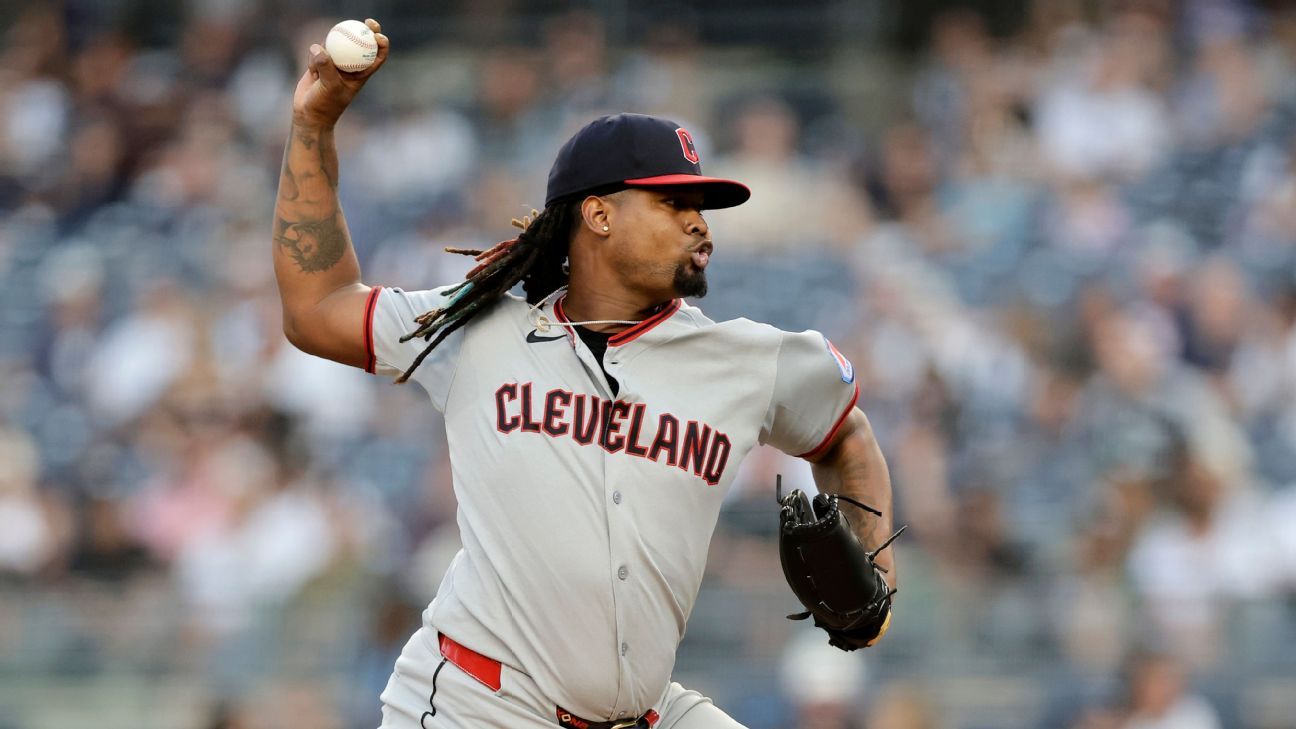
Former Cleveland Guardians pitchers Emmanuel Clase and Luis Ortiz have been indicted on charges related to a betting scheme, the latest in a series of betting scandals that have rocked the sports world.
Two and a half weeks after charging an NBA player and two coaches for their alleged involvement in betting schemes, the U.S. Attorney’s Office for the Eastern District of New York accused Clase and Ortiz of fixing individual pitches to benefit unidentified bettors. The indictment alleges that Clase and Ortiz received bribes for agreeing to manipulate their performances so their partners could profit from bets on the location and speed of their pitches.
“Through this scheme, the defendants defrauded gambling platforms, deprived Major League Baseball and the Cleveland Guardians of their honest services, illicitly enriched themselves and their accomplices, deceived the public, and betrayed America’s national pastime,” the U.S. Attorney’s Office stated in the statement announcing the indictment.
MLB expert Jeff Passan and sports betting reporter David Purdum explain the details of the allegations, what the future holds for those involved and what this means for MLB.
Who are Clase and Ortiz, and what is the chronology of their involvement?
Class was the closer for the Cleveland Guardians and one of the best relievers in the Major Leagues, a three-time All-Star and two-time award winner Mariano Rivera for Reliever of the Year. The Guardians acquired Ortiz, a 26-year-old right-handed starting pitcher, in a trade with the Pittsburgh Pirates last December.
According to the indictment filed Sunday by federal prosecutors, Clase, 27, began the alleged pitch-fixing scheme as early as May 2023. According to the indictment, he and an unidentified bettor focused on specific bets related to a particular pitch. Sometimes it was a question of whether it would be a ball or a strike. Sometimes it was a question of whether the speed would be faster or slower than a preset number of miles per hour. Other times, several bets were combined. According to prosecutors, all of this generated more than $400,000 in profits for bettors, and Clase received bribes that represented a fraction of the $12 million he has earned in his career and the $6.4 million he was scheduled to earn in 2026. Clase’s attorney stated that “he is innocent of all charges and looks forward to proving his innocence in court.”
Ortiz, whose lawyer also denied his client’s involvement on Sunday, reportedly joined the plot this season. On June 15, he threw the first pitch of the second inning of a game against the Seattle Mariners that resulted in a ball. Two bettors had wagered $13,000 on the outcome, and Ortiz, whose salary was $782,000, reportedly received $5,000 for the pitch and Class another $5,000 for facilitating the operation. They repeated the same operation on June 27, with payments of $7,000 each.
Shortly thereafter, IC360, a betting integrity company, flagged irregularities in bets placed by Ortiz, sparking an investigation by the U.S. Attorney’s Office in Brooklyn and leading MLB to launch its own investigation and suspend both players with pay, without disciplinary consequences. — Passan
What actions has MLB taken in the immediate aftermath?
On Monday, MLB announced that its authorized sports betting partners agreed to set a national limit of $200 for bets on individual pitches, such as whether they will be a ball or strike and their speed. Launch bets will also be banned from being included in matched bets, in a bid to discourage manipulation. — Purdum
Can you bet on the speed of the pitches?
Yes, some sportsbooks have offered over/under bets on the velocity of individual pitches, as well as whether certain pitches would be a strike, a ball, or a hit. These types of bets are commonly known as microbets or bets on specific moments within a game. Not all sportsbooks offer them, and the limits are usually much lower than bets on the winner of a game or the total number of runs scored, for example. — Purdum
How much money did the alleged bettors win?
According to the indictment, bettors allegedly placed hundreds of bets related to specific Class pitches during the 2023 and 2025 seasons, often including them in parlay bets to increase profits. In total, federal prosecutors allege that bettors won $400,000 betting on Class pitches and $50,000 on the two Ortiz pitches that were called. — Purdum
How did MLB detect these pitches?
One sportsbook detected unusual interest in betting on Ortiz’s first pitches in two June games. According to the alert, the specific launches were:
Ortiz’s first pitch in the bottom of the second inning, which would be a hit or a ball, in a June 15 game against the Seattle Mariners.
Ortiz’s first pitch in the top of the inning, which would be a hit or a ball, in a June 27 game against the St. Louis Cardinals.
Following the second incident, the bookmaker notified Integrity Compliance 360 (IC360), a company that monitors the American betting market for suspicious activity. IC360 sent an alert to its customers, including Major League Baseball, other sports leagues, sportsbooks and state gaming regulators, warning about the unusual interest in betting and requesting more information.
MLB stated that it notified federal authorities at the beginning of its investigation into the alleged scheme.
Could pitch-fixing, like that alleged against Clase and Ortiz, influence the outcome of a game?
It’s easy to say: “It’s just a ball, right?” However, in 2025, after a pitcher began facing a batter with a strike, they were hitting .217/.263/.344. In contrast, at-bats that began with a ball resulted in a .255/.375/.431 average. Therefore, the difference between a single ball and a strike represented 38 points of batting average, more than 100 points of on-base percentage and almost 90 points of slugging percentage.
Although the sample size is much smaller for the players involved in this case, the difference in on-base percentage, in particular, is notable. Against Clase in 2025, hitters posted a .239/.250/.364 average on 0-1 counts and .258/.383/.303 on 1-0 counts. For Ortiz, the average was .202/.240/.313 with a 0-1 count and .234/.411/.421 with a 1-0 count. — Passan
What is the situation of the pitchers with the MLB while the legal processes develop?
Clase and Ortiz remain on paid administrative leave without disciplinary action while MLB’s investigation into alleged pitch-fixing remains open. When there is a possible crime involving players, the league generally does not close its investigation or impose sanctions until it knows the full scope of the case and the evidence presented by authorities.
Following the opening of the indictment, the MLB could proceed with sanctions against Clase and Ortiz before the trial. The league’s criteria is simple: If you sanction someone, do you think the evidence would be strong enough to hold up on appeal?
Until MLB reaches that point, players can remain on leave, which currently extends through the start of spring training. If at any time MLB believes that the evidence from its investigation and that of the government shows that Clase and Ortiz violated Rule 21, which prohibits players from betting on baseball, the league could impose a lifetime ban. The government’s case against Clase and Ortiz does not need to be resolved before MLB can sanction the players.
Last year, the MLB banned San Diego Padres infielder for life, Tucupita Marcanoafter an investigation revealed that he had placed more than 400 bets on baseball. — Passan
Are there other players or team personnel potentially involved or is the investigation limited to Clase and Ortiz?
In a statement in August, the Guardians stated: “We have been informed that no other players or members of the Club’s staff are expected to be affected” by the investigation. According to sources, that opinion has not changed. — Passan
Is there any connection between the alleged MLB betting scheme and the NBA betting scandal?
Both cases are being handled by the U.S. Attorney’s Office for the Eastern District of New York, but as of Monday no other connections between the two alleged schemes had been revealed. None of the bettors who allegedly participated in the MLB betting scheme were named in the NBA’s indictment. — Purdum
