
White smoke for the future of F1: “I am excited about the new engines, I think everyone will be excited about the new power units”
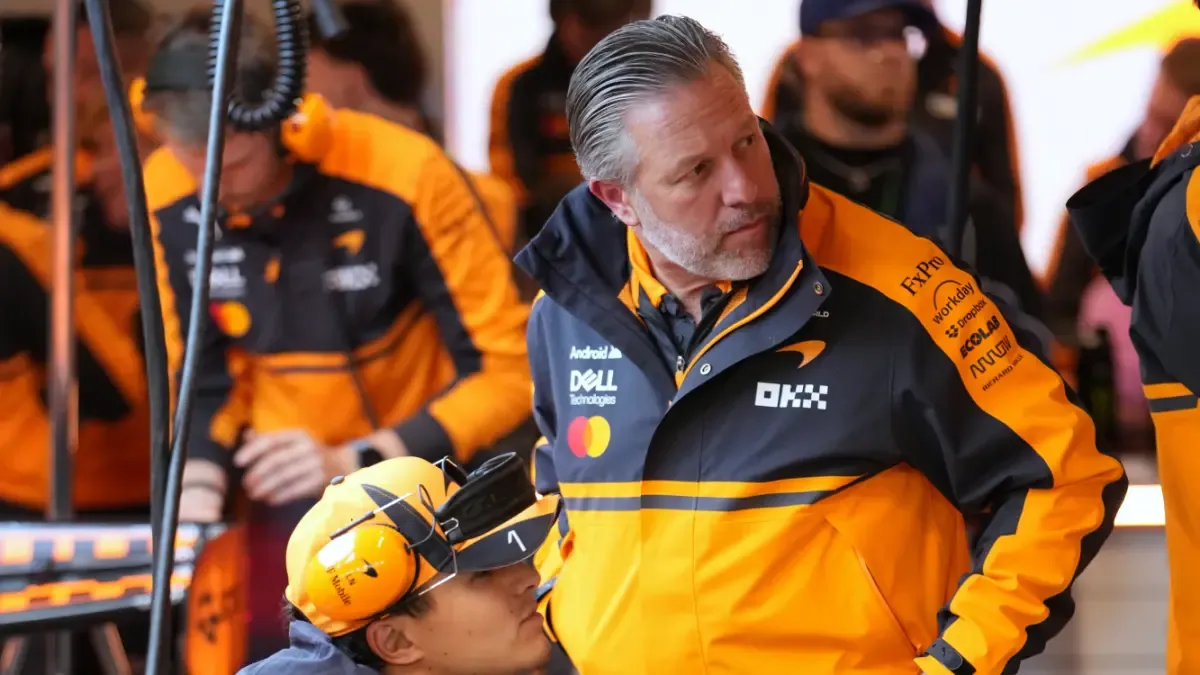
On the first day of F1 Las Vegas GP, marked by the rain of Libres 1 and with unrepresentative times due to how wet the track was still in Free Practice 2, the focus was on the future of the competition. At yesterday’s team leaders’ press conference, Zak Brownen, CEO of McLaren Racingconfirmed that “there is a principle of agreement” for the return of V8 engines, bringing forward the change to the year 2030. And although Flavio Briatoreexecutive director of Alpinemake sure that you still “the last details remain to be finalized”the path is clear, basically, because all parties agree.
The current F1 engines of the new regulation of 2026 have 50% of the total electrical powersomething that has caused a lot of criticism among pilots and fans due to the total change in driving style, in which the management of electrical energy is too important. The pilot loses time if he attacks an apex more and brakes looking for the last millimeter. Doing so means spending more energy and being less efficient in the final lap time, something that goes against the nature of this sport.
Furthermore, the driver loses a lot of importance because it is the engine’s ‘software’ that decides how much power to deliver in each corner to optimize the turn.
It is for this reason that for months the president of the FIA, Ben Sulayem has declared himself in favor of the return of the V8 on multiple occasions. Months ago, the president of the FIA pointed towards the idea of eliminate electrical energy of the new 2030 engines, as they could meet their zero emissions goal by using sustainable fuels. Another option was to remove the turbo. All this, to ensure that the cars can be less heavy and smaller, so that the hand-to-hand fights are better.
And finally, after Monday’s meeting between engine manufacturers, FIA and F1, there is white smoke to work on the new 2030 regulations, so that the V8 engines return, as they recognized this Friday Zak Brown, as well as Flavio Briatore (Alpine) and Dan Towriss (Cadillac)at the team leaders’ press conference held in Las Vegas.
“I’m excited about the new engines, I think everyone will be excited about the new power units. But there are also a lot of other things going on to continue to evolve this sport. Both the FIA and Formula 1 are doing a great job”said Brown.
I’m excited about the new engines, I think everyone will be excited about the new power units
However, Ben Sulayem’s initial idea has undergone changes: it will be an engine 2.1-liter turbo V8, but it will still have an electric part, although reduced, of 200 kW (instead of the current 350 kW). And of them, according to the ‘BBC’, only 100 will be available at all times and the other 100 will be used only for overtaking mode.
And there will be a turbo, something that seems to have been requested Audi and Honda. Therefore, the electrical part will not be eliminated nor will the turbo be eliminated in order to reduce fuel consumption and avoid having to carry a larger tank (it would go against the idea of smaller and lighter cars). By maintaining the turbo, you also nip in the bud the possibility you flirted with Ben Sulayemthat of a return of refueling that will not occur.
According to the ‘BBC’, this agreement in principle will finally cause Cadillac to postpone the start date of its start as an engine manufacturer. It would start in 2030, with the new regulation, and would continue to be a customer of Ferrari engines until then.
The sound from before will not return
“I am very happy. It is the right path. We need an engine that makes a lot of noise and is simple. We need to compete with that type of engine”said Flavio. But that won’t be the case either. The memory of the V8s that were in F1 from 2006 to 2013 is useless, because the noise of the engines is expected to be similar to that of the current ones. The imposing music and roar of the engines of yesteryear, which many fans crave, will not be recovered. And in an F1 with more and more urban races, it is not possible to compete within cities as it clearly exceeds the permitted decibel limits.
I am very happy. It is the right way. We need a motor that makes a lot of noise and is simple. We need to compete with that type of engine

And despite the lack of that enormous sound, some of the pilots applaud this principle of agreement, especially those most critical of the current regulations. Although a large part of them prefer to show caution in this regard, although in favor of simpler and cheaper engines.
“It’s frustrating that we didn’t have them already in 2014. From 2014 to 2030 or 2031, that means we will have lost 16 or 17 years of real racing,” he said. Alonso about it. ️“Deciding to change engines 8 months after releasing the new regulations explains that this was not the right decision,” he added.
It’s frustrating that we didn’t have them already in 2014. From 2014 to 2030 or 2031, that means we will have lost 16 or 17 years of real racing
Verstappen, another of the most critical drivers along with Fernando towards the new regulations, applauded the consensus: “It is a good decision for the sport.” Above all, he made it clear that it is about recovering a pure driving style. Although I would even go further: “If it were completely up to me, of course I would go back to a V10 or something similar. It sounds even better, but I know it’s not realistic. If it were up to me, I would remove the turbo and eliminate the (electric) power. Although perhaps it could be used as an overtaking system, but without depending so much on the battery. Although then they wouldn’t let us race on some circuits. “We would make too much noise,” exclaimed Max.
